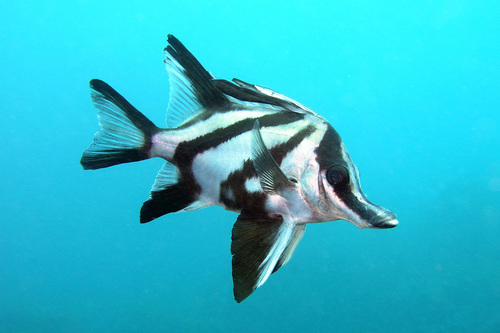
Longsnout Boarfish
Pentaceropsis recurvirostris
With a snout like a straw and a striking suit of racing stripes, the Longsnout Boarfish is one of the most distinctive residents of Australia's southern reefs. This fascinating bottom-dweller is a master of precision feeding in the cool temperate waters of the Great Southern Reef.
Quick Identification
Size
Grows up to 60 cm (24 inches) in length; typically weighs between 1.5 and 3 kg (3.3–6.6 lbs).
Colors
Silvery-white body with three bold, dark brown to black diagonal bands; dorsal and pelvic fins often show yellow or dark highlights.
Key Features
- Extremely elongated, tubular snout
- Tall, sharp-spined dorsal fin resembling armor
- Three prominent dark diagonal stripes across a compressed body
- Small mouth located at the very tip of the snout
When You’ll See Them
Geographic range
Where Does the Longsnout Boarfish Live?
The Longsnout Boarfish is a proud native of the Southern Hemisphere, found exclusively along the temperate southern coast of Australia. Its range stretches from the central coast of New South Wales, around the southern tip of Tasmania, and westward to the southern reaches of Western Australia. As a regional endemic, it is a hallmark species of the Great Southern Reef, thriving in the cool, nutrient-rich waters that define the Australian coastline.
Basemap © OpenStreetMap contributors
Behavior
The Longsnout Boarfish is a generally solitary and somewhat shy species that spends much of its time hovering near the sea floor. Unlike many reef fish that dart quickly, the boarfish moves with a slow, methodical grace, using its specialized snout to probe into crevices and soft sediments for food. While they are usually found alone, small groups may occasionally congregate in areas with high food density or during the breeding season.
These fish are not known to be aggressive and often ignore divers or underwater cameras if approached slowly. They are highly specialized for life on temperate reefs, where their striped pattern provides surprisingly effective camouflage against the shadows of kelp forests and rocky overhangs. Because they are not a primary target for commercial fisheries and have low catch rates in trawls, their interactions with humans are primarily limited to recreational diving and underwater photography.
EverydayEarth exclusive
Camera Tips
Capturing the Longsnout Boarfish requires a waterproof action camera or a dedicated underwater housing. For coastal residents with access to a private jetty or pier in southern Australia, mounting a camera to a weighted tripod or a pier pylon at depths of 5 to 10 meters can yield excellent results. Position the lens to face a mix of sandy bottom and rocky reef edge, as this 'edge habitat' is where they most frequently forage for worms.
Natural light is best for capturing their striking silver and black stripes, so aim for mid-morning or early afternoon when the sun is directly overhead. If you are using a stationary camera, avoid using bright artificial lures; instead, look for areas with high brittle star activity. The boarfish is naturally curious about slow-moving objects but can be easily spooked by sudden vibrations or high-intensity strobes.
Set your camera to a high frame rate (60fps or higher) to capture the subtle movement of their tubular snout as they feed. Because these fish are often found in deeper, darker waters, ensure your camera has a wide aperture or good low-light performance. If you are deploying a camera from a boat or pier, a 'drop cam' setup with a stabilizing fin will help keep the footage steady against coastal currents.
Similar Species
Species that look similar or are commonly confused with Longsnout Boarfish.
Frequently Asked Questions
Record Longsnout Boarfish at your habitat
Connect a camera to start building your own species record — AI identifies every visitor automatically.