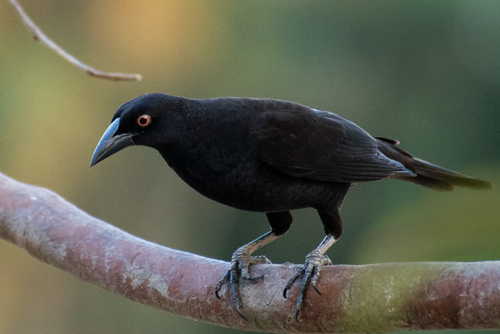
Giant Cowbird
Molothrus oryzivorus
The largest of the cowbirds, this iridescent Neotropical specialist is famous for its clever brood parasitism and striking neck ruff. A common visitor to forest edges and cattle pastures, it brings a touch of dramatic mystery to any backyard camera setup.
Quick Identification
Size
Length: 33-37 cm (13-14.5 in); Weight: 140-210g (4.9-7.4 oz)
Colors
Males are glossy black with violet, blue, and bronze iridescence; females are a sootier, matte black or dark brown. Both sexes feature distinctively pale yellow or white iridescence in the iris.
Key Features
- Large size and thick neck ruff
- Striking pale yellow or white eyes
- Deeply iridescent black plumage in males
- Heavy, pointed black bill
When You’ll See Them
Sightings on EverydayEarth
Jun 26, 2026
A variety of tropical birds are active at the fruit feeder. A Giant Cowbird watches from a mossy branch on the left while several female or immature Crimson-backed Tanagers and a Clay-colored Thrush forage on fruit slices spread across the platform.
Jun 24, 2026
A vibrant male Crimson-backed Tanager, showcasing its deep red feathers and characteristic silver beak, shares the feeder with a much larger Giant Cowbird. The charcoal-colored cowbird, with its notable pale eyes, is busy foraging through the mossy surface while the tanager looks on.
Geographic range
Where Does the Giant Cowbird Live?
The Giant Cowbird is a widespread resident of the Neotropics, spanning a massive territory from southern Mexico through Central America and deep into South America. Its core range includes the Amazon Basin and extends as far south as northern Argentina, while also inhabiting the Caribbean islands of Trinidad and Tobago. These birds are most commonly found in lowland regions where their preferred host species, such as Oropendolas, build their iconic hanging colonies.
Basemap © OpenStreetMap contributors
Behavior
The Giant Cowbird is a master of the 'stealth' lifestyle, known primarily as a brood parasite. Unlike most birds, it never builds a nest, instead laying its eggs in the hanging nests of Oropendolas and Caciques. Interestingly, this relationship isn't always purely parasitic; in areas with high botfly populations, the Giant Cowbird chick may actually protect the host chicks by eating the fly larvae, creating a strange and complex biological partnership.
These birds are highly social and are often seen in small flocks or following livestock through pastures to snatch up insects kicked up by the animals' hooves. When courting, the male performs a dramatic display, puffing out his thick neck ruff to appear much larger than he is, while emitting a series of squeaky, metallic whistles. They are wary of humans but have adapted well to suburban edges where food is plentiful.
EverydayEarth exclusive
Camera Tips
To capture the Giant Cowbird on camera, your best strategy is to locate their host species. Find a colony of Oropendolas or Caciques—look for the large, sock-like nests hanging from high branches. Position your camera on a nearby tree or post with a clear view of the approaches to these nests. The Giant Cowbird will often spend time scouting the colony from a mid-level perch before attempting to slip into a host nest to lay an egg.
In a backyard setting, these birds are attracted to platform feeders. Use a mix of cracked corn, sunflower seeds, and chunks of soft fruit like bananas or papayas to lure them in. Because of their dark, iridescent plumage, camera placement is critical. Avoid pointing the camera directly toward the sun, which can cause 'silhouetting.' Instead, aim for a position where the morning sun hits the bird's side, which will highlight the brilliant blue and purple sheen of the male's feathers and the striking pale color of their eyes.
Set your AI-powered camera to 'High Sensitivity' and use a fast shutter speed if possible. Giant Cowbirds are flighty and move with quick, jerky motions when feeding. If your camera supports 4K video, use it; the fine detail of the male’s neck ruff during a display is a spectacular sight. Since they are most active in the early morning, ensure your camera has fresh batteries or a solar attachment to handle the dawn peak of activity.
Similar Species
Species that look similar or are commonly confused with Giant Cowbird.
Bronzed Cowbird
Much smaller than the Giant Cowbird, with a red eye instead of pale white/yellow.
Great-tailed Grackle
Has a significantly longer, V-shaped tail and a longer, thinner bill compared to the cowbird.
Shiny Cowbird
Much smaller and lacks the distinctive thick neck ruff of the Giant Cowbird.
Frequently Asked Questions
Record Giant Cowbird at your habitat
Connect a camera to start building your own species record — AI identifies every visitor automatically.