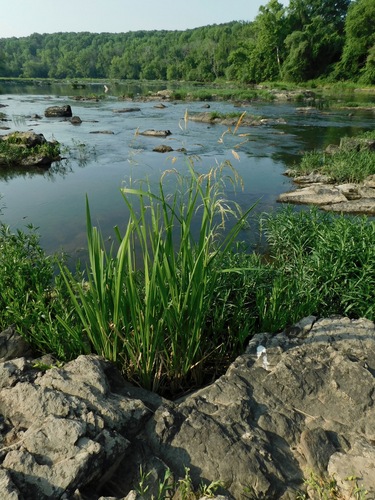
Giant Cutgrass
Zizaniopsis miliacea
A towering sentinel of the southern wetlands, Giant Cutgrass is as beautiful as it is formidable. With its razor-edged leaves and massive bronze flower clusters, it provides a lush, protective sanctuary for a hidden world of marsh wildlife.
Quick Identification
Size
Height: 2.5–4.5 meters (8–15 feet); Leaf width: 2–4 centimeters (0.8–1.6 inches)
Colors
Bright blue-green to olive leaves with a prominent silver-white midrib; flowering panicles are pale green to bronze-tan
Key Features
- Razor-sharp, serrated leaf margins
- Towering height reaching up to 15 feet
- Large, airy flower clusters up to 2 feet long
- Distinctive silver-white central vein on leaves
When You’ll See Them
Behavior
Giant Cutgrass is a dominant, perennial wetland grass that grows in massive, impenetrable colonies. Unlike many other grasses, it spreads aggressively through a network of thick, creeping rhizomes (underground stems), allowing it to quickly stabilize shorelines and colonize muddy banks. It is known as a 'pioneer species' because of its ability to take over disturbed wetland areas and provide immediate structural cover.
While it is stationary, it interacts dynamically with its environment by acting as a biological filter, trapping sediment and absorbing excess nutrients from the water. For humans and animals, it acts as a formidable barrier; the edges of the leaves are lined with microscopic silica teeth that can easily slice through skin or thin clothing, which is how it earned the name 'cutgrass.' It provides essential nesting sites for marsh birds and serves as a nursery for various aquatic insects.
EverydayEarth exclusive
Camera Tips
When setting up a camera to capture Giant Cutgrass, your goal is to showcase its impressive scale and the wildlife it hosts. Position your camera on a sturdy stake or tripod about 3 to 4 feet off the ground, angled slightly upward. This 'worm's-eye view' emphasizes the plant's towering height against the sky. For the best color saturation, ensure your camera faces away from the sun to capture the light hitting the blue-green leaves, particularly during the 'Golden Hour' of late afternoon when the bronze seed heads glow.
Because Giant Cutgrass moves significantly in the wind, false triggers are a common issue. To combat this, set your camera's motion sensitivity to a medium or low setting, or use a 'Detection Zone' feature to focus on the more stable, lower stalks where birds are likely to land. If your camera supports it, a time-lapse mode set to 15-minute intervals can beautifully document the grass's growth and the changing light levels in the marsh over a single day.
To capture the animals that frequent the cutgrass, place your camera near the edge of a stand where it meets open water. This 'edge habitat' is a high-traffic zone for Least Bitterns, Red-winged Blackbirds, and various waterfowl. If you are targeting insects like the Broad-winged Skipper, focus your lens closely on the flowering panicles during June and July. Remember to wear thick gloves and long sleeves when placing your camera, as the serrated leaves can cause painful 'grass cuts' during installation.
Similar Species
Species that look similar or are commonly confused with Giant Cutgrass.
Frequently Asked Questions
Record Giant Cutgrass at your habitat
Connect a camera to start building your own species record — AI identifies every visitor automatically.