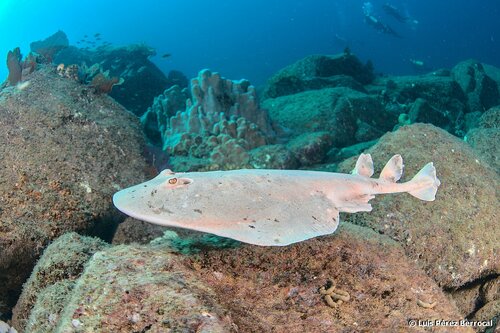
Giant Electric Ray
Narcine entemedor
Meet the 'Intimidator' of the Pacific shallows—a master of camouflage that carries its own biological batteries. The Giant Electric Ray is a fascinating nocturnal neighbor for those living along the Eastern Pacific coast.
Quick Identification
Size
Typically reaches a total length of 60–90 cm (24–35 inches), weighing between 2–5 kg (4.4–11 lbs).
Colors
Uniformly tan, grayish-brown, or sandy brown on the upper surface; creamy white or pale yellowish on the underside.
Key Features
- Circular or oval pectoral disc
- Two prominent dorsal fins of nearly equal size
- Thick, muscular tail without a stinging spine
- Kidney-shaped electric organs visible through the skin on either side of the head
When You’ll See Them
Geographic range
Where Does the Giant Electric Ray Live?
The Giant Electric Ray is a signature species of the Eastern Pacific Ocean, with a native range that spans from the southern Gulf of California down through the tropical waters of Central America to Panama and occasionally as far south as Peru. This ray thrives in the coastal shelf environments of Mexico, Costa Rica, and Colombia, favoring the warm, nutrient-rich shallows near the shore. While it is a marine specialist, it is frequently found in bays and estuaries where sandy substrates provide the perfect environment for its ambush-style lifestyle.
Basemap © OpenStreetMap contributors
Behavior
The Giant Electric Ray is a sluggish, bottom-dwelling species that spends much of its day buried under a thin layer of sand. By pumping water through spiracles on top of its head, it can stay oxygenated while remaining almost entirely hidden from both predators and prey. Despite the intimidating name, these rays are generally non-aggressive toward humans, though they will deliver a significant bio-electric shock if stepped on or handled, which they use as a primary defense mechanism.
As nocturnal hunters, they become much more active after sunset. They use their specialized electric organs—composed of modified muscle tissue—to emit low-voltage pulses for navigating and locating prey in the dark, and high-voltage bursts to stun small fish or invertebrates. Unlike stingrays, they lack a venomous barb, relying entirely on their 'battery power' and camouflage for survival. In social terms, they are mostly solitary but may congregate in high-quality feeding grounds or during mating seasons.
EverydayEarth exclusive
Camera Tips
To capture a Giant Electric Ray on camera, you will need a specialized underwater housing or a dedicated marine trail camera. Since these rays are nocturnal and spend much of their time buried, your best bet is to position the camera at the interface where a rocky reef meets a sandy flat. This 'ecotone' is a high-traffic highway for rays moving between their daytime hiding spots and nighttime hunting grounds.
Standard PIR (passive infrared) motion sensors rarely work effectively underwater. Instead, set your camera to a time-lapse mode—taking a photo every 30 to 60 seconds—or use a camera with 'pixel-change' detection if the water is clear. Because the Giant Electric Ray is active in near-total darkness, high-quality infrared (IR) LEDs are essential. Ensure your IR lights are angled slightly away from the lens to avoid 'backscatter,' where light reflects off suspended sand particles, creating a snow-globe effect in your footage.
Placement is key: mount your camera on a heavy, low-profile weighted base or a sand-screw about 12-18 inches off the seafloor, angled slightly downward. You can entice a ray to stay in front of the lens longer by using a 'scent bag' filled with crushed shrimp or squid secured just out of the frame. This won't necessarily make them 'attack' the bait, but the scent will cause them to linger and forage in the area, giving you much better opportunities for a clear ID.
Similar Species
Species that look similar or are commonly confused with Giant Electric Ray.
Frequently Asked Questions
Record Giant Electric Ray at your habitat
Connect a camera to start building your own species record — AI identifies every visitor automatically.