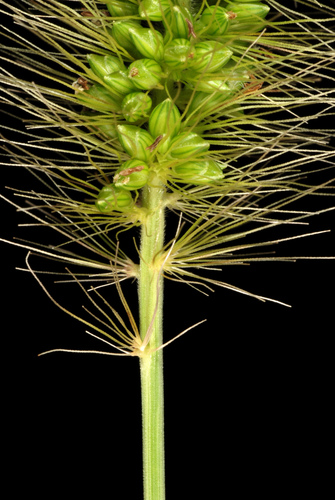
giant foxtail
Setaria faberi
A tall, elegant grass with iconic drooping seed heads, the giant foxtail is a late-summer staple of the backyard landscape. It serves as a natural bird feeder, attracting a colorful variety of seed-eating songbirds to its fuzzy stalks.
Quick Identification
Size
Stems reach 3 to 6 feet (0.9 to 1.8 meters) tall; seed heads are 3 to 7 inches (7 to 18 cm) long
Colors
Bright lime green leaves and stems; seed heads turn straw-colored or tan as they mature
Key Features
- Nodding or drooping seed heads that arch downward
- Fine, short hairs covering the upper surface of the leaf blades
- Bristly 'foxtail' appearance with soft, hair-like awns
- Tall, clump-forming growth habit reaching up to 6 feet
When You’ll See Them
Behavior
Giant foxtail is a vigorous summer annual grass that thrives on sunlight and disturbed soil. It is known for its rapid growth cycle, germinating in the warm spring soil and quickly reaching its full height by mid-summer. Unlike many other grasses that stand rigid, the giant foxtail is characterized by its graceful, nodding habit; as the seed head matures and fills with grain, its weight causes the stalk to arch toward the ground.
In the backyard ecosystem, this plant acts as both a competitor and a provider. While it can aggressively colonize garden beds, it provides essential structure and cover for ground-dwelling insects and small mammals. Its primary interaction with wildlife occurs in late summer and autumn, when its heavy seed production becomes a primary food source for a wide variety of local birds and rodents.
EverydayEarth exclusive
Camera Tips
To capture the best images of giant foxtail, position your camera at a low angle, roughly 2 feet off the ground. This perspective emphasizes the 'nodding' curve of the seed heads against the sky. Because the plant's fine bristles (awns) are semi-translucent, they look spectacular when backlit. Aim your camera toward the east or west to catch the low-angle light of the morning or evening 'golden hour,' which will make the foxtails appear to glow.
If you are using an AI-powered camera to spot wildlife, giant foxtail is an excellent 'anchor' plant to monitor. Place your camera 5 to 8 feet away from a dense cluster of mature seed heads during August and September. You are likely to capture high-quality footage of Northern Cardinals, Song Sparrows, and Mourning Doves as they land on the stalks to feast on the ripening seeds. The weight of the birds often causes the stalks to bob and sway, creating dynamic video clips.
Be mindful of your camera's motion sensitivity settings. The long, flexible stems of the giant foxtail are highly reactive to wind. On breezy days, the constant movement can trigger hundreds of 'false' recordings. We recommend setting a detection zone that focuses specifically on the seed heads or reducing sensitivity slightly to ensure you are only capturing the movement of visiting animals rather than the grass itself.
For those interested in the plant's biology, try a time-lapse setting. By taking one photo every 6 hours from June through August, you can create a fascinating visual record of the plant's 'nodding' behavior—watching the seed heads emerge straight and slowly begin to arch as they grow heavy with grain.
Similar Species
Species that look similar or are commonly confused with giant foxtail.
Frequently Asked Questions
Record giant foxtail at your habitat
Connect a camera to start building your own species record — AI identifies every visitor automatically.