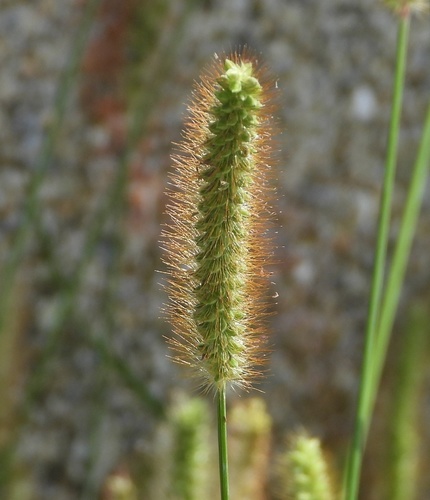
yellow foxtail
Setaria pumila
A golden staple of summer meadows and backyard edges, yellow foxtail is more than just a common weed. Its fuzzy, glowing seed heads provide a vital feast for songbirds and a beautiful subject for any nature photographer.
Quick Identification
Size
20 cm to 1.3 meters (8 inches to 4.3 feet) in height
Colors
Lime-green to purplish stems with golden-yellow or tawny seed heads
Key Features
- Stiff, cylindrical seed heads 2-15 cm long
- Dense, yellow-tinged bristles beneath each spikelet
- Long, twisting leaf blades with hairless upper surfaces
- Stems often exhibit a reddish-purple tint at the base
When You’ll See Them
Behavior
Yellow foxtail is a resilient annual grass that functions as a vital part of the backyard ecosystem, though many gardeners know it simply as a stubborn weed. It thrives in disturbed soils, making it a frequent sight along driveway edges, garden beds, and sidewalk cracks. It uses a C4 photosynthetic pathway, which allows it to remain lush and productive even during the heat of mid-summer when other grasses might brown and go dormant.
As a prolific seed producer, yellow foxtail plays a crucial role in supporting local bird populations. A single plant can produce thousands of seeds, which stay on the stalk well into the autumn, providing a reliable food source for ground-feeding birds. While it doesn't move like an animal, its rapid growth and ability to colonize open patches of earth demonstrate an aggressive survival strategy that ensures its presence in almost any sunny suburban environment.
EverydayEarth exclusive
Camera Tips
Yellow foxtail provides an excellent opportunity for "wildlife staging" on your trail camera. Because the seed heads are a magnet for sparrows, finches, and doves, placing your camera at a low "critter-eye" level—about 6 to 12 inches off the ground—will allow you to capture high-quality footage of birds foraging. For the best visual results, position the camera so the rising or setting sun is behind the grass; this backlighting catches the translucent bristles and creates a glowing golden aura around the plant.
Be mindful of the wind when setting your camera’s PIR (Passive Infrared) sensitivity. Because these grasses are tall and flexible, they sway significantly in the breeze, which can lead to hundreds of "false triggers" if your camera is set to its highest sensitivity. We recommend using a "Medium" sensitivity setting or using the "Masking" feature available on high-end AI cameras to ignore the moving grass while still capturing the heat signature of visiting animals.
If you are using a camera with a time-lapse mode, yellow foxtail is a fantastic subject for documenting the life cycle of a backyard habitat. From mid-summer to late autumn, you can record the transition of the flower heads from green to a deep, rusty yellow. If you're specifically looking to capture animal interactions, try clear-cutting a small "landing pad" in front of a dense patch of foxtail and focusing your lens there. The birds will naturally congregate at the edge of the cover to feed on the fallen seeds, giving you clear, unobstructed shots of species that are normally quite shy.
Similar Species
Species that look similar or are commonly confused with yellow foxtail.
Frequently Asked Questions
Record yellow foxtail at your habitat
Connect a camera to start building your own species record — AI identifies every visitor automatically.