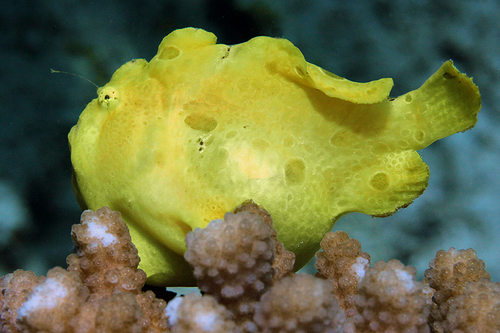
Giant Frogfish
Antennarius commerson
The ultimate master of disguise, the Giant Frogfish 'walks' along the ocean floor and uses a built-in fishing rod to lure its dinner. This incredible predator can change its color to match any sponge, making it the reef's most elusive resident.
Quick Identification
Size
Up to 38 cm (15 inches) in length; typically heavy-bodied for their size.
Colors
Highly polymorphic; individuals can be bright yellow, orange, red, green, brown, or solid black, often with circular spots mimicking sponge pores.
Key Features
- Large, globose body with smooth but 'warty' skin
- First dorsal spine modified into a fishing rod (illicium) with a simple lure
- Thick, limb-like pectoral fins used for walking on the seabed
When You’ll See Them
Geographic range
Where Does the Giant Frogfish Live?
The Giant Frogfish is a wide-ranging inhabitant of the tropical Indo-Pacific. Its territory begins in the warm waters of the Red Sea and East Africa, stretching across the Indian Ocean to the islands of Indonesia and the Great Barrier Reef. In the Pacific, its reach extends as far north as southern Japan and as far east as the Hawaiian Islands and the coast of Panama, making it one of the most widely distributed frogfish species in the world.
Basemap © OpenStreetMap contributors
Behavior
The Giant Frogfish is a master of patient deception, spending the vast majority of its life motionless. Rather than swimming, it uses its modified pectoral and pelvic fins to 'walk' across the reef floor or perch atop sponges. This sedentary lifestyle allows it to blend perfectly with its surroundings; it can even change its color over the course of several weeks to match a new habitat. It is a solitary creature, generally only interacting with others of its species during mating encounters.
Despite its sluggish appearance, the Giant Frogfish possesses one of the fastest predatory strikes in the ocean. When a potential meal approaches, the frogfish remains still and begins to flick its 'fishing rod' to entice the prey. Once the target is within range, the frogfish expands its oral cavity in just six milliseconds, creating a powerful vacuum that pulls the prey whole into its mouth. To humans, they are remarkably docile and will often allow divers to observe them from just inches away without moving.
EverydayEarth exclusive
Camera Tips
Capturing the Giant Frogfish on an underwater camera is an exercise in spotting the 'invisible.' Because they are masters of camouflage, look for sponges that appear to have a face or 'limbs.' These fish are highly sedentary and can stay in the exact same square foot of reef for months. If you find one, it is a perfect candidate for a stationary underwater camera setup or an ROV (Remotely Operated Vehicle) observation. Use a tripod or a weighted mount to keep the frame steady, as even slight currents can cause camera shake that ruins the illusion of the fish’s stillness.
Lighting is the most critical factor for high-quality footage. In the underwater environment, red and orange tones are lost first; because many Giant Frogfish are vibrant yellows or reds, you must use high-CRI (Color Rendering Index) video lights to reveal their true appearance. Position your lights at 45-degree angles to the side of the camera lens to avoid 'backscatter,' which is the reflection of light off of sand or plankton in the water. This lighting setup will highlight the subtle skin textures that make this species so fascinating.
For those using AI-triggered cameras, be aware that the frogfish's strike is faster than most motion sensors can react to. To capture a feeding event, it is best to record in a continuous loop or use a high-frame-rate setting (at least 60fps). If you observe the frogfish beginning to 'wave' its esca (the lure at the end of its rod), this is your signal that a strike is imminent. Position the camera at eye-level with the fish to create a compelling, intimate portrait that showcases its grumpy, downturned mouth and watchful eyes.
Similar Species
Species that look similar or are commonly confused with Giant Frogfish.
Frequently Asked Questions
Record Giant Frogfish at your habitat
Connect a camera to start building your own species record — AI identifies every visitor automatically.