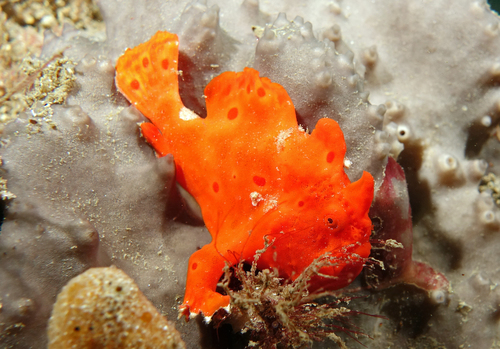
Painted Frogfish
Antennarius pictus
A master of disguise and the ultimate ambush predator, the Painted Frogfish transforms the reef into its personal hunting ground. With its sponge-like skin and a built-in fishing rod, this "walking" fish is one of the ocean's most captivating sights.
Quick Identification
Size
Up to 30 cm (12 inches) in length; weight varies based on body mass but remains stocky and robust.
Colors
Extremely variable camouflage; colors range from bright yellow, orange, and red to green, brown, or solid black. Often decorated with circular spots (ocelli) resembling sponge pores.
Key Features
- Modified dorsal spine acting as a fishing lure (esca)
- Thick, skin-covered body with sponge-like texture
- Pectoral and pelvic fins resemble limbs for "walking"
- Small, circular spots or 'ocelli' scattered across the body
When You’ll See Them
Geographic range
Where Does the Painted Frogfish Live?
This striking marine resident is native to the warm waters of the Indo-Pacific region. Its vast territory stretches from the Red Sea and the coast of East Africa all the way to the Hawaiian Islands and the Society Islands in the South Pacific. Within this range, it is commonly spotted in the biodiversity hotspots of Indonesia, the Philippines, and Australia’s Great Barrier Reef, thriving in coastal environments where sponge growth provides the perfect cover.
Basemap © OpenStreetMap contributors
Behavior
The Painted Frogfish is a master of camouflage and patience, spending much of its life stationary, mimicking the sponges or corals surrounding it. Instead of swimming in the traditional sense, it uses its hand-like pectoral fins to "walk" across the seafloor or clamber over reef structures. It is a solitary creature, primarily interacting with others only during brief mating encounters, where the smaller male may follow a larger female.
This species is a highly efficient ambush predator. It remains perfectly still while waving its "fishing rod" (the illicium) tipped with a lure (the esca) to attract curious prey. When a target gets close enough, the frogfish expands its mouth cavity instantly, creating a vacuum that sucks the prey in at speeds faster than the human eye can follow. They are generally indifferent to human divers, making them excellent, if elusive, subjects for observation.
EverydayEarth exclusive
Camera Tips
Capturing the Painted Frogfish on an underwater trail camera requires a "set it and forget it" approach in a high-activity reef zone. Because these fish are masters of disguise, your camera must be placed extremely close to suspected hunting grounds—typically near large barrel sponges or branching corals where frogfish like to perch. Use a macro lens setting if available, as these fish often remain motionless for hours, allowing for stunning detail. A low-angle mount on a weighted tripod or a flexible arm mount is essential to capture the "walking" motion of their pectoral fins along the substrate.
Lighting is your biggest challenge underwater. Since the Painted Frogfish often inhabits shaded crevices or deeper reefs where red light is filtered out, using an external video light with a warm color temperature will reveal their true, vibrant colors. Avoid using high-intensity strobes that might startle the fish or cause "backscatter" (lighting up particles in the water). Instead, use a diffused, continuous light source to illuminate the esca (lure) as it moves, which creates a dynamic focal point for your footage.
To increase your chances of capturing a strike, look for a "sweet spot" where small damselfish or gobies congregate. Positioning your camera about 12 to 18 inches away from the fish, angled slightly upward, provides the best perspective of its cavernous mouth. Be patient; the strike of a frogfish lasts only milliseconds, so high-frame-rate settings (60fps or higher) are recommended to capture the action in slow motion. Check your camera housing seals and battery life religiously, especially if leaving the unit submerged for several hours.
Similar Species
Species that look similar or are commonly confused with Painted Frogfish.
Frequently Asked Questions
Record Painted Frogfish at your habitat
Connect a camera to start building your own species record — AI identifies every visitor automatically.