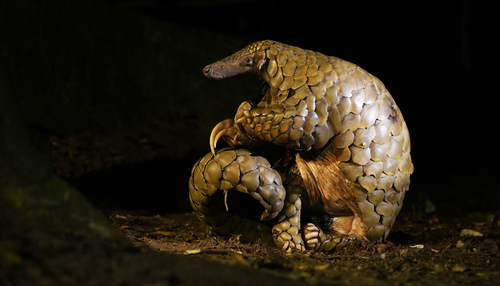
Giant Ground Pangolin
Smutsia gigantea
The largest of all pangolin species, this 'scaly anteater' is a relic of prehistoric design. An endangered marvel of the African rainforest, it is as powerful as it is elusive.
Quick Identification
Size
Length: 1.4-1.8 m (4.6-5.9 ft); Weight: 30-38 kg (66-84 lbs)
Colors
Brownish-grey to tan keratin scales; pale, scaleless skin on the underbelly and inner limbs
Key Features
- Massive overlapping keratin scales covering the entire body except the belly
- Heavy, thick tail used for balance
- Enormous, curved claws on the front feet
- Long, tubular snout with no teeth
When You’ll See Them
Geographic range
Where Does the Giant Ground Pangolin Live?
The Giant Ground Pangolin is native to the tropical regions of Middle Africa. Its range forms a broad belt across the equator, stretching from West African nations like Guinea and Ghana, through the dense Congo Basin of Gabon and the DRC, into the forested regions of Uganda and western Kenya. While they are found across a large geographic area, they are rarely seen and inhabit primary forests and protected savanna-forest mosaics where human disturbance is minimal.
Basemap © OpenStreetMap contributors
Behavior
The Giant Ground Pangolin is a solitary and elusive nocturnal giant, spending its daylight hours hidden deep within underground burrows. Unlike its smaller, tree-climbing relatives, this species is strictly terrestrial. It moves with a distinctive, slow-moving gait, often tucking its front claws inward to protect them while walking on its knuckles or the outer edges of its feet. Despite their heavy armor and lumbering appearance, they are surprisingly capable swimmers and can even stand on their hind legs to sniff the air for predators or prey.
When threatened, the Giant Ground Pangolin employs its most famous defense: rolling into a tight, impenetrable ball. Its sharp-edged scales create a protective barrier that even a lion's teeth struggle to pierce. In social terms, they are very private animals; males and females typically only interact during the brief mating window. They communicate primarily through scent marking, using specialized glands to signal their presence to other pangolins in the area.
EverydayEarth exclusive
Camera Tips
Capturing a Giant Ground Pangolin on camera requires extreme patience and a deep understanding of their local environment. These animals are highly sensitive to white light, so it is essential to use a 'No-Glow' or high-quality Black IR (Infrared) camera. Standard red-glow LEDs can spook them, causing them to roll into a ball or flee the area. Set your camera to take video bursts of 15-20 seconds; their slow movement means a single photo often only captures a tail or a blurry snout.
Position your camera low to the ground—roughly 30 to 45 cm (12-18 inches) high—facing a known game trail or a large, active termite mound. Pangolins are creatures of habit and will often use the same paths for weeks. If you can locate a burrow entrance (look for large, excavated holes with smooth, worn sides), set the camera at a 45-degree angle about 3 meters back. This ensures you catch them as they emerge for their nightly foraging.
Avoid using food baits, as pangolins are specialists and won't be attracted to standard lures. Instead, focus on water sources during the dry season. A camera overlooking a small forest pool or a muddy wallow is often your best bet. Ensure your camera's trigger speed is under 0.5 seconds, as although they move slowly, they can be surprisingly quiet as they drift through the frame. Finally, check your batteries frequently; the humid tropical environments they inhabit can drain power quickly.
Similar Species
Species that look similar or are commonly confused with Giant Ground Pangolin.
Frequently Asked Questions
Record Giant Ground Pangolin at your habitat
Connect a camera to start building your own species record — AI identifies every visitor automatically.