Giant kokopu
Galaxias argenteus
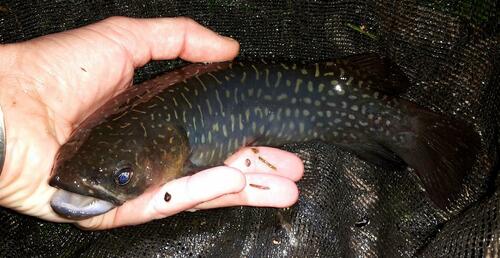
The Giant kokopu is the undisputed heavyweight of New Zealand's freshwater world. A cryptic beauty with golden 'star-map' markings, this elusive native fish is a sentinel of healthy, slow-flowing waterways.
Quick Identification
Size
Up to 58 cm (23 in) in length and weighing up to 2.7 kg (6.0 lb)
Colors
Dark olive-brown to deep black background adorned with intricate golden or silver patterns resembling stars, crescents, or crackled lines; belly is typically lighter
Key Features
- Largest member of the Galaxiidae family
- Gold or silver 'crackled' markings on a dark body
- Stocky, powerful build with fins set far back near the tail
- Lacks scales, possessing a thick and leathery skin
When You’ll See Them
Geographic range
Where Does the Giant kokopu Live?
The Giant kokopu is a proud endemic of New Zealand, found nowhere else on Earth. It maintains a widespread but patchy distribution across the North and South Islands, and is also found on Stewart and Chatham Islands. This species is primarily a lowland specialist, rarely moving far inland or to high altitudes, as it relies on accessible pathways to the sea for its amphidromous life cycle. They are most commonly found in coastal catchments where original wetland and forest cover remains intact.
Basemap © OpenStreetMap contributors
Behavior
The Giant kokopu is a master of stealth and a true 'sit-and-wait' predator. Unlike many fish that actively cruise for food, this species prefers to remain perfectly still under the cover of undercut banks, fallen logs, or overhanging vegetation. They are primarily nocturnal, emerging from their woody fortresses at dusk to hunt. Their large eyes are well-adapted to low-light conditions, allowing them to spot movement both above and below the water's surface.
In terms of social dynamics, Giant kokopu are generally solitary and can be quite territorial of their preferred 'lie' or hiding spot. Large individuals may occupy the same deep pool for years if the habitat remains undisturbed. While they are often described as shy, they are incredibly bold when it comes to feeding, often lunging with surprising speed to snatch prey from the surface. They have a long lifespan, with some individuals estimated to live over 20 years.
EverydayEarth exclusive
Camera Tips
Capturing the Giant kokopu requires a specialized approach since they are entirely aquatic and mostly active after dark. For backyard stream monitoring, the best results come from using a waterproof action camera (like a GoPro) or a dedicated underwater trail camera. Mount your camera on a weighted base or a short stake driven into the stream bed, facing a known hiding spot like a hollow log or an undercut bank. Ensure the camera is angled slightly upward toward the surface to capture the silhouette of the fish as it hunts for falling insects.
Since these fish are nocturnal, you will need a camera with high-quality infrared (IR) capabilities to avoid spooking them with bright white light. If you are using an external IR illuminator, place it a few feet away from the camera to reduce 'backscatter'—the reflection of light off suspended particles in the water which can make the footage look murky. Clear water is essential for good footage, so try to set up your gear during dry spells when the stream is not 'tannin-stained' or muddy from recent rain.
To attract a Giant kokopu into the frame, look for a deep, slow-moving pool. You can encourage them to appear by mimicking a 'food drop'—carefully placing a few large earthworms or crickets near the camera's field of view just before dusk. Because they are highly territorial, once you find a resident fish, it is likely to return to the same spot every night, allowing you to fine-tune your camera placement over several days. Be patient; these giants move slowly and deliberately until the moment they strike.
Similar Species
Species that look similar or are commonly confused with Giant kokopu.
Frequently Asked Questions
Record Giant kokopu at your habitat
Connect a camera to start building your own species record — AI identifies every visitor automatically.