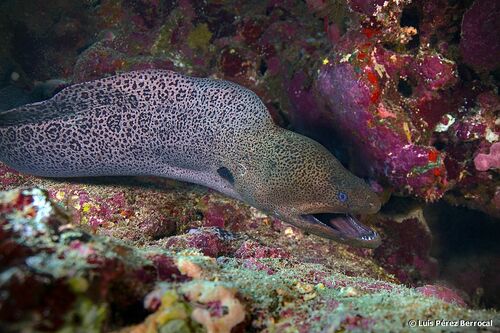
Giant Moray
Gymnothorax javanicus
The undisputed heavyweight of the Indo-Pacific reefs, the Giant Moray is a master of stealth and power. This massive, spotted predator is a favorite for underwater photographers, often seen peering out from coral fortresses with a watchful eye.
Quick Identification
Size
Up to 3 meters (9.8 feet) in length; weight can reach up to 30 kg (66 lbs)
Colors
Brownish-yellow to grey-green base color; juveniles have large black spots, while adults develop leopard-like dark spots that fade towards the tail.
Key Features
- Massive, muscular body with a thick head
- Large black spots or 'ink blots' around the gill openings
- Constantly gaping mouth used for respiration
- Dorsal fin starts just behind the head and runs the length of the body
When You’ll See Them
Geographic range
Where Does the Giant Moray Live?
Native to the expansive Indo-Pacific region, the Giant Moray thrives in warm tropical waters. Its range extends from the Red Sea and the coast of East Africa across to the Pitcairn Islands, reaching as far north as southern Japan and as far south as New Caledonia and the Hawaiian Islands. While they are most abundant in core coral reef zones, they are also found in the coastal waters of northern Australia and throughout the Indonesian archipelago.
Basemap © OpenStreetMap contributors
Behavior
The Giant Moray is a formidable apex predator of the reef, known for its sit-and-wait hunting strategy. During the day, it is typically found tucked into rocky crevices or coral heads with only its head protruding. Despite its fierce appearance, the constant opening and closing of its mouth is simply the eel pumping oxygenated water over its gills. They are largely solitary creatures that maintain a home range, often returning to the same favored 'apartment' in the reef for long periods.
Interestingly, Giant Morays are one of the few species known to engage in interspecific cooperative hunting; they have been observed working alongside roving coral groupers to flush prey out of hiding spots. While generally indifferent to divers and underwater cameras, they can become defensive if their territory is invaded or if they are provoked. Their eyesight is relatively poor, but they possess an extraordinary sense of smell used to locate prey in the dark.
EverydayEarth exclusive
Camera Tips
Capturing a Giant Moray requires specialized underwater housing or a dedicated marine trail camera. For the best results, look for 'cleaning stations' on the reef—areas where small wrasse or shrimp congregate. Morays frequently visit these spots to have parasites removed, offering a perfect opportunity for a stationary camera to catch them in a relaxed state. Secure your camera mount to a dead coral base or a weighted tripod to prevent it from being moved by the tidal surge.
Because Giant Morays are most active during the crepuscular and nocturnal hours, an external light source is essential. Use a wide-angle video light with a warm temperature or a red filter to avoid startling the eel. Position the light at a 45-degree angle from the camera lens to reduce 'backscatter' from particles in the water. Setting your camera to record 30-second 4K video clips is far more effective than still photos, as it captures the eel's rhythmic breathing and serpentine movements.
Placement is everything; look for large, dark holes in the reef structure that show signs of life nearby. If you find a crevice with a resident eel, place the camera at a respectful distance (at least 2-3 feet) to avoid a defensive strike. Be patient, as these eels may stay tucked away for hours before emerging to hunt. Ensure your camera's motion sensor is high-sensitivity, as the slow, fluid motion of an eel can sometimes be missed by standard triggers.
Similar Species
Species that look similar or are commonly confused with Giant Moray.
Frequently Asked Questions
Record Giant Moray at your habitat
Connect a camera to start building your own species record — AI identifies every visitor automatically.