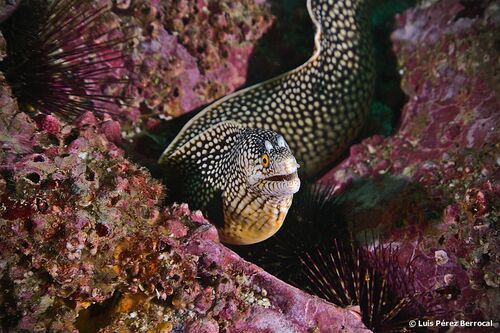
Honeycomb Moray
Muraena melanotis
A striking master of disguise in the Atlantic reefs, the Honeycomb Moray is easily recognized by its beautiful reticulated pattern. These shy but powerful eels are the hidden sentinels of rocky crevices, emerging under the cover of night to hunt.
Quick Identification
Size
Grows to a maximum length of about 1 metre (3.3 feet)
Colors
Dark brown to blackish base with a high-contrast honeycomb or reticulated pattern of white or pale yellow spots; features a distinct dark blotch at the gill opening
Key Features
- Intricate honeycomb-like network of light spots over a dark base
- Prominent black blotch covering the gill opening
- Blunt snout with four distinct tubular nostrils
- Scaleless, muscular body that can reach 1 metre in length
- Continuous dorsal, caudal, and anal fins forming a single fringe
When You’ll See Them
Geographic range
Where Does the Honeycomb Moray Live?
The Honeycomb Moray is a wide-ranging inhabitant of the Atlantic Ocean, making its home on both the eastern and western shores. You can find these eels tucked into the rocky reefs of West Africa and the oceanic islands like Cape Verde, as well as along the coastal waters of Brazil and parts of the Caribbean. They thrive in tropical and subtropical zones, preferring the stability of shallow marine environments where crevices and caves are abundant.
Basemap © OpenStreetMap contributors
Behavior
The Honeycomb Moray is a primarily nocturnal predator that spends its daylight hours tucked away in the safety of rocky crevices or coral labyrinths. While they may appear aggressive because they constantly open and close their mouths, this 'gaping' behavior is actually a vital respiratory function, used to pump oxygen-rich water over their gills rather than a threat display. They are solitary creatures that exhibit high site fidelity, often returning to the same 'home' crevice for years.
In the reef ecosystem, these eels play a fascinating social role through symbiotic relationships. They are frequently seen allowing cleaner shrimp or small wrasses to pick parasites and dead skin from their bodies, even inside their mouths. While they are generally shy and will retreat when approached by humans, they are formidable hunters at night, using their exceptional sense of smell to track down prey in total darkness.
EverydayEarth exclusive
Camera Tips
To capture high-quality footage of a Honeycomb Moray, you will need a waterproof action camera or a specialized underwater trail camera equipped with a depth-rated housing. Since these eels are primarily nocturnal and stay tucked into crevices, stability is key. Use a weighted tripod or a heavy diving weight with a tripod mount to secure your camera on the sandy bottom near a known reef crevice. Avoid placing the camera directly in front of their hole, as this can be perceived as a threat; instead, angle it at 45 degrees to capture the eel as it emerges to hunt.
Lighting is the most critical factor for night-time reef photography. Moray eels have sensitive eyes, so using a bright white spotlight can cause them to retreat. Instead, opt for a camera with infrared capabilities or use a red-filtered dive light, which is less visible to many marine species. If you are using white light, ensure it is diffused and not pointed directly into the crevice. Setting your camera to record in high frame rates (60fps or higher) will help you capture the fluid, serpentine movement of the eel as it swims.
If you have a coastal backyard that borders a tropical canal or rocky shoreline, you can encourage a visit by creating a 'scent trail.' Place a small amount of oily fish bait, like sardines or mackerel, inside a perforated PVC pipe or a mesh bait bag. Secure this near your camera's field of view. The eel's keen sense of smell will draw it out of its lair to investigate the aroma. Never attempt to hand-feed a moray, as they have poor eyesight and can deliver a powerful, bacteria-rich bite if they mistake your fingers for food.
Check the local tide charts and set your camera to trigger during the rising tide at night, as morays often take advantage of higher water levels to explore shallower sections of the reef. Ensure your camera's housing is clear of algae or salt crystals before deployment, and always use a safety tether in case the camera becomes dislodged by a strong surge or a curious larger predator like a shark.
Similar Species
Species that look similar or are commonly confused with Honeycomb Moray.
Spotted Moray
Has smaller, more irregular dark spots on a lighter background and lacks the large, distinct black blotch at the gill opening.
Mediterranean Moray
Features a narrower head and a different spot pattern; it is found primarily in the Mediterranean and eastern Atlantic, rarely overlapping in the tropics.
Frequently Asked Questions
Record Honeycomb Moray at your habitat
Connect a camera to start building your own species record — AI identifies every visitor automatically.