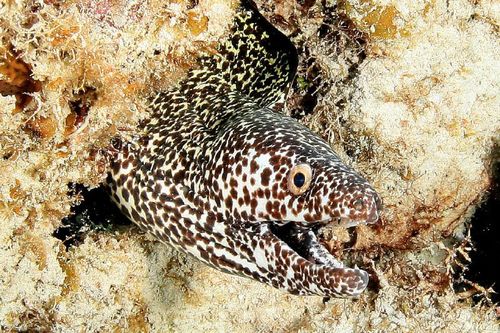
Spotted Moray
Gymnothorax moringa
With its stunning 'leopard' spots and piercing gaze, the Spotted Moray is a master of the Atlantic's rocky shadows. This nocturnal hunter is a cornerstone of the reef ecosystem, blending serpentine grace with a powerful presence.
Quick Identification
Size
Typically 60 cm (24 in) in length but can grow up to 2 m (6.6 ft); weight reaches up to 2.51 kg (5.5 lb)
Colors
Cream, white, or pale yellow base covered in a dense pattern of overlapping dark brown to purplish-black spots; white chin and jaw
Key Features
- Elongated snake-like body with a continuous dorsal fin
- Pale yellow or white base color with dark brown spots
- Distinctive white chin and pale interior of the mouth
When You’ll See Them
Geographic range
Where Does the Spotted Moray Live?
The Spotted Moray is native to the warm waters of the Atlantic Ocean, with a core range extending across the Western Atlantic from North Carolina and Bermuda through the Gulf of Mexico and the Caribbean down to Brazil. They are also found in the Eastern Atlantic, particularly around the Mid-Atlantic islands such as St. Helena and Ascension. Thriving in tropical and subtropical climates, they are one of the most common moray species encountered by coastal residents and divers in the Americas.
Basemap © OpenStreetMap contributors
Behavior
The Spotted Moray is a solitary and primarily nocturnal hunter that spends its daylight hours tucked away in the safety of reef crevices or rocky outcrops. Observers often see them with only their heads protruding from a hole, rhythmically opening and closing their mouths. While this gaping behavior is often misinterpreted as a threat display, it is actually the eel's way of breathing, as they must manually pump water over their gills to extract oxygen.
At night, these eels become active predators, using their keen sense of smell to navigate the reef in search of food. They are known for a unique 'knotting' behavior, where they twist their muscular bodies into a loop to gain leverage while pulling prey from tight spaces or tearing larger items into smaller pieces. Despite their fierce appearance, they are generally shy toward humans unless they feel cornered or are habituated to hand-feeding, which can lead to accidental bites.
EverydayEarth exclusive
Camera Tips
To successfully capture a Spotted Moray on an underwater camera, focus your efforts on 'edge' habitats where rocky structures meet sandy bottoms. If you live on a coastal canal or have access to a dock, mounting a waterproof camera to a piling near the seafloor is an excellent strategy. Aim the lens toward a known crevice or a pile of riprap stones, as these eels prefer to stay close to cover rather than swimming in open water. Ensure the camera is weighted or securely tethered to prevent tidal currents or larger marine life from displacing it.
Lighting is the most critical factor for nocturnal eel photography. Since Spotted Morays are most active after dark, utilize infrared (IR) illumination to observe their natural hunting behavior without startling them. If you prefer color footage, use a low-intensity, wide-angle video light. Avoid high-output white flashes, which can cause the eel to retreat deep into its lair. Setting your camera to record short video clips (15-30 seconds) is superior to still photos, as it captures the serpentine movement and the characteristic jaw motion that makes this species so fascinating.
Attracting a Spotted Moray to your camera's field of view is best achieved through scent. You can use a 'chum cage'—a small, perforated container filled with oily fish like sardines—positioned about two feet in front of the lens. The scent will draw the eel out of its hole to investigate, providing a clear view of its leopard-like patterns. Be sure to place the bait up-current from the camera so the scent trail leads directly to your lens. For the best results, monitor the tides; morays are often most active during the transition between low and high tide when prey is on the move.
Lastly, be mindful of water clarity. In 'backyard' coastal environments like mangroves or docks, visibility can drop after heavy rain. Plan your camera deployments during periods of calm weather and clear water to ensure the AI can properly identify the intricate spotting on the eel's skin. Regularly clean the lens housing of algae or barnacle growth, especially if the camera is a permanent fixture under a dock, to maintain the crisp detail needed for species identification.
Similar Species
Species that look similar or are commonly confused with Spotted Moray.
Frequently Asked Questions
Record Spotted Moray at your habitat
Connect a camera to start building your own species record — AI identifies every visitor automatically.