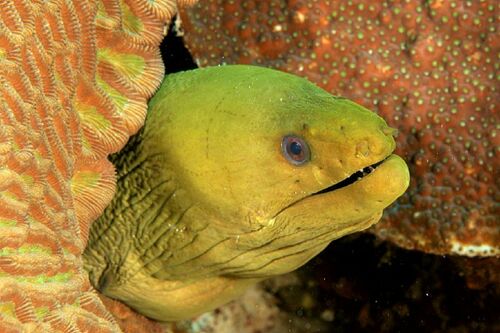
Green Moray
Gymnothorax funebris
The largest moray eel in the Atlantic, this neon-green giant is a master of the reef's shadows. With its powerful, scale-less body and sharp teeth, it is one of the most iconic and misunderstood predators of the Western Atlantic.
Quick Identification
Size
Up to 2.5 meters (8.2 feet) in length and weighing up to 29 kilograms (64 pounds)
Colors
Uniformly bright neon green to brownish-olive; the green color comes from a yellow mucus layer covering its naturally dark-brown skin
Key Features
- Long, snake-like body with no scales or pectoral fins
- Yellowish mucus coating creates a vivid green appearance
- Large mouth frequently held open to pump water over gills
- Continuous fin running along the dorsal, caudal, and anal ridges
When You’ll See Them
Geographic range
Where Does the Green Moray Live?
The Green Moray is native to the Western Atlantic Ocean, primarily inhabiting the warm waters of North and South America. Its core range extends from the Florida Keys and the Gulf of Mexico through the entire Caribbean basin down to the southern coast of Brazil. While it is a permanent resident of these tropical regions, individuals are occasionally found as far north as New Jersey and Bermuda during the warmer summer months.
Basemap © OpenStreetMap contributors
Behavior
The Green Moray is a solitary and largely nocturnal predator that spends its daylight hours tucked into the safety of reef crevices, rocky holes, or submerged debris. While it may look menacing as it constantly opens and closes its mouth, this is actually a vital respiratory function used to pump oxygen-rich water over its gills. During the day, it is typically sedentary, showing only its head to passersby while it waits for nightfall to begin its hunt.
When the sun sets, the Green Moray leaves its lair to forage across the reef. It relies heavily on its highly developed sense of smell to locate prey in the dark, as its eyesight is relatively poor. Despite their reputation for being aggressive, these eels are generally shy around humans and will only bite if they feel threatened or if they mistake a human hand for food during misguided feeding attempts. In the wild, they play a crucial role as apex predators in maintaining the balance of the reef ecosystem.
EverydayEarth exclusive
Camera Tips
To capture a Green Moray on an AI-powered camera, you will need a specialized waterproof housing or a dedicated underwater trail camera. If you have a backyard dock, seawall, or rocky shoreline, mount the camera 1–2 feet above the seafloor facing a known crevice or a cluster of rocks. Morays are creatures of habit and will often return to the same "den" every morning after hunting, so finding an established hole is your best bet for consistent footage.
Because these eels are nocturnal, your camera must have strong infrared (IR) capabilities. Standard white lights can be used but may attract smaller fish that swarm the lens, obscuring the Moray. Set your camera to video mode rather than still photos; the undulating, serpentine movement of a Green Moray as it leaves its den is one of the most spectacular sights in marine wildlife photography. A 20-second clip is usually enough to capture them emerging for a night of hunting.
Angle the camera at a 45-degree side view relative to the den's entrance. This allows the AI to better identify the eel's elongated profile and captures the full length of the body if it decides to stretch out. Avoid placing the camera directly in the mouth of the hole, as the Moray may bump into it or become wary of the obstruction. If you are in a legal area for it, placing a small, perforated container with oily bait like mackerel nearby can entice a shy eel to come fully into the frame for a closer look.
Similar Species
Species that look similar or are commonly confused with Green Moray.
Frequently Asked Questions
Record Green Moray at your habitat
Connect a camera to start building your own species record — AI identifies every visitor automatically.