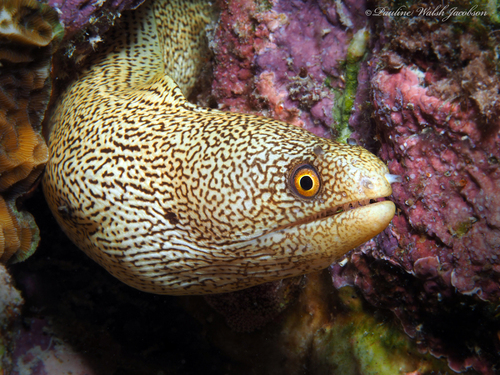
Goldentail Moray
Gymnothorax miliaris
With its jewel-like golden spots and striking yellow-tipped tail, the Goldentail Moray is a shy but stunning resident of the Atlantic's coral reefs.
Quick Identification
Size
Typically 40-60 cm (16-24 in) in length, with a maximum recorded size of around 70 cm (28 in).
Colors
Dark chocolate brown or purplish-black body covered in a dense pattern of tiny, bright golden-yellow spots. The tip of the tail is usually a solid, vibrant gold.
Key Features
- Dense pattern of tiny yellow spots
- Solid golden-yellow tail tip
- Short, blunt snout compared to other morays
- Pale yellow to white eyes
When You’ll See Them
Geographic range
Where Does the Goldentail Moray Live?
The Goldentail Moray is a quintessential resident of the tropical and subtropical Atlantic Ocean. It is most commonly found in the Western Atlantic, ranging from the coast of Florida and the Bahamas through the Caribbean Sea and Gulf of Mexico, extending as far south as Brazil. It also maintains populations in the Eastern Atlantic, specifically around oceanic islands such as Cape Verde, Saint Helena, and Ascension Island.
Basemap © OpenStreetMap contributors
Behavior
The Goldentail Moray is a secretive and primarily nocturnal predator that spends the majority of its daylight hours tucked deep within the recesses of coral reefs or rocky crevices. Despite its somewhat menacing appearance due to the constant opening and closing of its mouth, this is actually a respiratory action used to pump oxygen-rich water over its gills. It is considered one of the more docile moray species, though it will defend its crevice if it feels cornered.
Interestingly, the Goldentail Moray is often seen in a symbiotic relationship with cleaner shrimp. These small crustaceans are permitted to crawl over the eel's skin and even inside its mouth to eat parasites and dead tissue, providing a cleaning service in exchange for protection. While they are solitary hunters, they are occasionally observed in the same vicinity as other reef predators like groupers, sometimes benefiting from the 'flushing' of prey caused by the larger fish's movements.
EverydayEarth exclusive
Camera Tips
To capture a Goldentail Moray on an underwater trail camera or a dock-mounted system, location is everything. Look for 'pock-marked' reef structures or limestone ledges with numerous small holes. These eels are habitual and will often return to the same hole for weeks at a time. Secure your camera housing as close to the bottom as possible, angling the lens slightly upward to catch the eel's head as it emerges. Because they are often found in dark recesses, using a camera with a high-quality low-light sensor or integrated red LED lights is crucial; red light is less likely to spook them compared to white light.
If you are filming in a private area where attractants are permitted, the scent of crushed oily fish like sardines or bonito can be highly effective. Goldentail Morays have a sophisticated sense of smell and will follow a scent trail directly to your camera lens. Place the scent source slightly to the side of the lens rather than directly in front of it to ensure the eel stays in the center of the frame while it investigates. Be sure to use a fast shutter speed or a high frame rate (60fps or higher), as their movements can be deceptively quick when they strike at prey.
For those using cameras on docks or sea walls in 'backyard' coastal areas like the Florida Keys, the best time to capture activity is during the incoming tide at night. The increased water movement often brings prey closer to their hiding spots, triggering higher activity levels. Ensure your camera is heavily weighted or tethered to a fixed structure, as tidal currents and the eel's own curiosity—they have been known to 'nudge' equipment—can easily shift your field of view.
Similar Species
Species that look similar or are commonly confused with Goldentail Moray.
Frequently Asked Questions
Record Goldentail Moray at your habitat
Connect a camera to start building your own species record — AI identifies every visitor automatically.