Chain Moray
Echidna catenata
A master of the shallows, the Chain Moray is famous for its stunning 'linked' pattern and its rare ability to crawl across land between tide pools. This striking eel is a favorite for backyard reef enthusiasts and coastal explorers alike.
Quick Identification
Size
Typically 30–45 cm (12–18 in), though exceptional specimens can reach 165 cm (65 in)
Colors
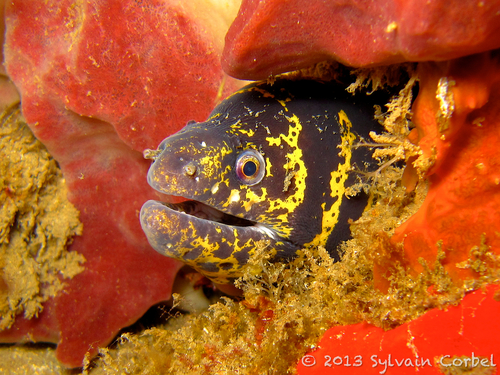
Dark brown, black, or deep purple base with a brilliant yellow or white interconnected 'chain' pattern; the eyes are often yellow
Key Features
- Blunt, rounded snout adapted for crushing shells
- Interconnected yellow-to-white chain-like markings
- No pectoral fins and a dorsal fin starting behind the head
- Small, pebble-like molariform teeth
When You’ll See Them
Geographic range
Where Does the Chain Moray Live?
The Chain Moray is a staple of the Western Atlantic’s warm coastal waters. Its range begins as far north as Bermuda and the southern tip of Florida, extending through the entire Caribbean basin and the Gulf of Mexico. It is frequently spotted along the coastlines of Central America and continues south to the tropical reefs of Brazil, as well as appearing near isolated Atlantic islands like Ascension and Saint Helena.
Basemap © OpenStreetMap contributors
Behavior
The Chain Moray is a reclusive but fascinating predator that breaks the mold of typical moray eels. Unlike its cousins that strike at passing fish, this species is a crustacean specialist. It is most famous for its ability to leave the water; during low tide, it has been observed slithering over damp rocks and seaweed to move between tide pools in search of trapped crabs. This amphibious behavior is rare among eels and makes them a thrilling find for coastal explorers.
By day, they are typically found wedged deep into rocky crevices or coral heads with only their blunt snouts protruding. They are generally more docile than larger morays but possess incredible jaw strength. While they are solitary hunters, they are often found in very shallow water—sometimes only inches deep—where larger predators cannot go. Their interactions with humans are minimal, as they prefer to retreat into holes when approached, though they can become curious in areas where they are frequently observed by snorkelers.
EverydayEarth exclusive
Camera Tips
Capturing the Chain Moray requires an underwater setup, specifically targeting the 'intertidal zone' where the ocean meets the shore. The best placement for an AI-powered camera is inside a permanent tide pool that remains filled even at low tide. Use a weighted tripod or a low-profile suction mount to secure the camera to a flat rock. Aim the lens toward deep crevices or undercuts in the rock, as these are the eel's preferred 'home base' where it waits for prey.
Baiting is highly effective for this species. Since they hunt by scent, placing a cracked crab or a mesh bag with crushed shrimp just inside the camera's field of view will almost certainly draw them out. Be sure to secure the bait so the eel doesn't simply drag it into a hole and out of sight. Because these eels are comfortable in extremely shallow water, you can often set your camera in just 6 to 12 inches of water, which provides excellent natural light and reduces the 'blue wash' common in deeper shots.
Timing is critical. While they are active day and night, the best action often occurs during a rising tide. As the water begins to flood the tide pools, the eels become highly active, sensing the movement of crabs. Set your camera to trigger on movement, but be mindful of swaying seaweed; adjusting the sensitivity or using a camera with animal-detection AI will help filter out 'false' triggers caused by the surf.
For the best visual results, try to capture them from a low 'eye-level' angle rather than looking straight down. This highlights their unique blunt-nosed profile and the intricate yellow chain pattern. If filming at night, use a camera with a red-light IR flash, as bright white lights can startle them and cause them to retreat back into their rocky fortresses.
Similar Species
Species that look similar or are commonly confused with Chain Moray.
Frequently Asked Questions
Record Chain Moray at your habitat
Connect a camera to start building your own species record — AI identifies every visitor automatically.