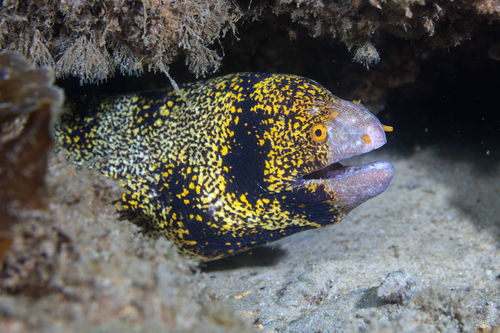
Snowflake Moray
Echidna nebulosa
With its striking star-patterned skin and curious personality, the Snowflake Moray is a favorite find for coastal explorers and underwater photographers. Unlike more aggressive eels, this specialized crab-hunter is a docile resident of shallow reefs and tropical tide pools.
Quick Identification
Size
Typically 50–70 cm (20–28 in), with a maximum length of up to 100 cm (39 in)
Colors
White or cream-colored body adorned with black, dendritic 'snowflake' blotches that contain one or more yellow spots at the center
Key Features
- Distinctive snowflake-shaped black markings with yellow centers
- Blunt, molar-like teeth designed for crushing shells
- Bright yellow eyes and prominent tubular nostrils
- Serpentine, slightly compressed body without scales
When You’ll See Them
Geographic range
Where Does the Snowflake Moray Live?
The Snowflake Moray is a quintessential resident of the Indo-Pacific region, boasting one of the most expansive distributions of any moray eel. Its native waters stretch from the eastern coast of Africa and the Red Sea across the Indian Ocean to the tropical islands of the Pacific, including Hawaii and the Pitcairn Islands. While they are a staple of the Great Barrier Reef and the Indonesian archipelago, they have also been established along the Pacific coast of Central America, ranging from the Gulf of California down to the coast of Colombia.
Basemap © OpenStreetMap contributors
Behavior
The Snowflake Moray is a shy and predominantly nocturnal predator that spends the daylight hours tucked away in the safety of reef crevices or under rock ledges. Unlike many of its more aggressive fish-eating relatives, this species is specialized for hunting crustaceans. It uses a highly developed sense of smell to locate prey in the dark, as its eyesight is relatively poor. When it finds a crab or shrimp, it uses its unique blunt teeth to crush the hard exoskeleton, a behavioral trait it shares with the Zebra Moray.
In the wild, Snowflake Morays are generally solitary, though they are known to be quite docile compared to other moray eels. They rarely show aggression toward humans unless they feel cornered or are accidentally provoked during hand-feeding. They are remarkably hardy and adaptable, often seen navigating very shallow water or shifting between tide pools during low tide. Their movement is characterized by a graceful, undulating motion that allows them to slip into incredibly tight spaces within the coral matrix.
EverydayEarth exclusive
Camera Tips
To capture high-quality footage of a Snowflake Moray, you will need a dedicated underwater action camera or a trail camera housed in a waterproof casing rated for at least 30 feet. Because these eels are most active at night, look for shallow tide pools or rocky reef flats during low tide where the water is calm. Position the camera at the base of a coral head or near a rocky crevice that looks like a potential 'den'—look for an opening with a clear path in front of it and signs of discarded shells nearby.
Lighting is the most critical factor for nocturnal marine life. Standard white LEDs can often startle Snowflake Morays, causing them to retreat into their holes. Instead, use a camera with infrared (IR) capabilities or an external red-light source. Red light is less visible to many marine creatures and will allow you to record their natural foraging behavior without causing stress. Set your camera to a wide-angle view, as these eels can be surprisingly long, and you want to capture their full serpentine movement as they glide past the lens.
Since Snowflake Morays rely heavily on their sense of smell rather than sight, you can use a 'scent lure' to bring them into the frame. Place a small amount of oily bait, such as crushed shrimp or mackerel, inside a perforated PVC pipe or a mesh bag. Secure this lure just outside the camera's field of view or at the edge of the frame. The scent will drift through the water, and the eel will often follow the trail directly to your lens, offering spectacular close-up shots of its unique snowflake markings.
For the best results, set your camera to record in short bursts (15-30 seconds) triggered by motion, or use a time-lapse setting if the water clarity is high. In tidal areas, be mindful of the rising tide; ensure your camera mount is weighted down with dive weights or securely tethered to a rock so it doesn't wash away. Early morning and late evening are peak transition times when they are most likely to be seen entering or leaving their daytime shelters.
Similar Species
Species that look similar or are commonly confused with Snowflake Moray.
Frequently Asked Questions
Record Snowflake Moray at your habitat
Connect a camera to start building your own species record — AI identifies every visitor automatically.