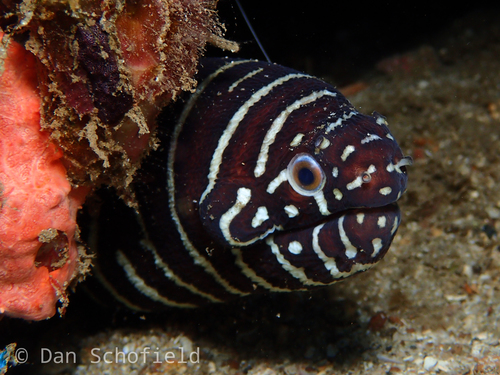
Zebra Moray
Gymnomuraena zebra
With its striking monochrome rings and surprisingly gentle nature, the Zebra Moray is the 'shell-cracker' of the reef. This nocturnal architect of the crevices is a favorite for underwater observers and backyard reef cameras alike.
Quick Identification
Size
Up to 1.5 meters (5 feet) in length; typically 0.5 to 1 meter (1.6 to 3.3 feet)
Colors
Dark chocolate brown to black body covered in numerous narrow, vertical white or cream-colored rings that wrap around the entire body.
Key Features
- Distinctive zebra-like black and white banding
- Blunt, rounded snout with molar-like teeth for crushing shells
- Thick, muscular serpentine body without pectoral or pelvic fins
When You’ll See Them
Geographic range
Where Does the Zebra Moray Live?
The Zebra Moray is a widespread inhabitant of the tropical Indo-Pacific region, flourishing in warm coastal waters. Its native range begins along the eastern coast of Africa and the Red Sea, extending across the Indian Ocean to the coral-rich waters of Southeast Asia, northern Australia, and the various island chains of the central Pacific, including Hawaii. On the eastern side of the Pacific, they are established along the coastlines of Mexico, the Gulf of California, and as far south as Colombia and the Galapagos Islands.
Basemap © OpenStreetMap contributors
Behavior
The Zebra Moray is a shy and reclusive member of the eel family, known for its remarkably docile temperament compared to other morays. Unlike many of its cousins that possess needle-sharp teeth for catching fish, the Zebra Moray has evolved specialized, pebble-like teeth specifically designed for crushing the hard exoskeletons of crustaceans. They spend the vast majority of the daylight hours tucked deep into reef crevices, often with only their heads protruding to survey the surrounding environment.
These eels are primarily nocturnal hunters, emerging under the cover of darkness to prowl the reef floor. They rely heavily on their acute sense of smell to track down prey hiding in rocky cracks. While they are solitary by nature, they are not territorial toward humans and are generally considered one of the safest eels to observe, as they prefer retreat over aggression. In a backyard reef or dock setting, they are predictable residents that often return to the same 'home' crevice for years.
EverydayEarth exclusive
Camera Tips
Capturing the Zebra Moray on an underwater 'backyard' or dock camera requires a focus on structural focal points. These eels are creatures of habit; identify a deep, dark crevice or a limestone overhang near the reef floor where they are likely to den. Position your camera approximately 12 to 18 inches from the opening of the hole, angling it slightly upward to capture the eel’s unique facial markings. Because they are most active at night, ensure your camera has a high-quality infrared (IR) sensor or a red-light mode, as bright white light can startle them and cause them to retreat for the remainder of the night.
If you are using a baited setup to draw them out for a full-body shot, use a scent-based lure. A perforated container filled with crushed crab or shrimp placed directly in front of the camera's field of view is highly effective. Zebra Morays have poor eyesight but an incredible sense of smell, and they will slowly 'snake' their way toward the scent. Secure your camera mount firmly to a weighted base or a permanent reef structure; morays are powerful and can easily displace a lightweight tripod if they bump into it while foraging.
For settings, a fast trigger speed is less important than a wide-angle view and good depth of field. Since their movement is slow and rhythmic, set your camera to record 20-second video clips rather than still photos. This allows you to witness their unique 'searching' behavior as they move their heads side-to-side. During the summer months when water temperatures rise, their metabolism increases and they may be more active during the twilight hours, making 'Golden Hour' an excellent time for hybrid light photography.
Similar Species
Species that look similar or are commonly confused with Zebra Moray.
Frequently Asked Questions
Record Zebra Moray at your habitat
Connect a camera to start building your own species record — AI identifies every visitor automatically.