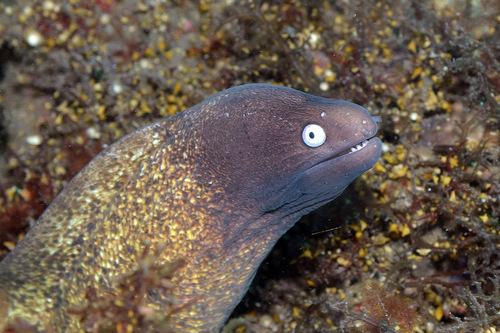
White-eyed Moray
Gymnothorax thyrsoideus
A ghostly face with piercing white eyes, this reef-dwelling eel is a master of the nocturnal hunt. Widely found across the Indo-Pacific, the White-eyed Moray adds a touch of mystery to every coral crevice.
Quick Identification
Size
Typically ranges from 40 to 65 cm (16 to 26 inches) in length; rarely exceeds 70 cm.
Colors
Pale grey to tan body covered in small dark brown freckles; the head is often a lighter grey-white, and the irises are a piercing white.
Key Features
- Distinctive bright white irises
- Pale grey or whitish face and snout
- Body densely covered in small dark spots or 'freckles'
- Small, slender build compared to larger morays
When You’ll See Them
Geographic range
Where Does the White-eyed Moray Live?
The White-eyed Moray is widely distributed throughout the tropical Indo-Pacific region. Its territory begins along the eastern coast of Africa and the Red Sea, stretching across the Indian Ocean to the islands of Southeast Asia, including Indonesia and the Philippines. In the Pacific, its range extends as far north as southern Japan and as far south as the Great Barrier Reef in Australia, reaching out to the central Pacific islands of French Polynesia. It is a strictly marine species, thriving in warm, stable water temperatures.
Basemap © OpenStreetMap contributors
Behavior
The White-eyed Moray is a secretive but common resident of tropical reefs. Unlike larger, more predatory morays that might dominate a reef, this species is relatively small and tends to be more cautious. During the daylight hours, it is almost exclusively found with only its head protruding from a hole or crevice in the coral. Interestingly, it is known to be quite social for an eel, often sharing its hiding spot with other White-eyed Morays or even different species of eels and cleaner shrimp.
As night falls, this eel becomes a stealthy hunter. It leaves its crevice to navigate the complex topography of the reef, using its highly developed sense of smell to track down prey. While they appear menacing because they constantly open and close their mouths, this is simply a respiratory action to pump water over their gills. In the presence of humans, they are generally docile and shy, preferring to retreat further into their burrows if they feel threatened.
EverydayEarth exclusive
Camera Tips
To capture high-quality footage of a White-eyed Moray, you will need an underwater camera setup, such as a GoPro in a dive housing or a dedicated reef-monitoring camera. Placement is everything: look for 'cleaning stations' or large coral heads (bommies) with visible holes. Position the camera on a weighted tripod or mount it to a nearby rock, ensuring the lens is aimed at a crevice where you see antennae of cleaner shrimp or the eel's head itself. A distance of 1 to 2 feet is ideal for capturing the fine details of their freckled skin.
Because they are most active at night, supplemental lighting is essential. However, many reef species are sensitive to bright white light. Use a video light with a red-light mode or a low-intensity warm beam to observe their natural hunting behavior without causing them to flee. If your camera allows for it, use a slow-motion setting (60 or 120 fps) to catch the quick, rhythmic movement of their breathing and the occasional rapid strike if they find a meal.
If you are monitoring a specific area over several days, you can encourage the eel to stay within the frame by using a scent lure. A small, perforated PVC pipe containing fish scraps or shrimp can be secured near the camera. The White-eyed Moray’s keen sense of smell will draw it out of its hole. Ensure your camera is set to a wide-angle view to capture the eel's full body as it snakes across the reef floor, as they are surprisingly graceful when they emerge from their homes.
Similar Species
Species that look similar or are commonly confused with White-eyed Moray.
Frequently Asked Questions
Record White-eyed Moray at your habitat
Connect a camera to start building your own species record — AI identifies every visitor automatically.