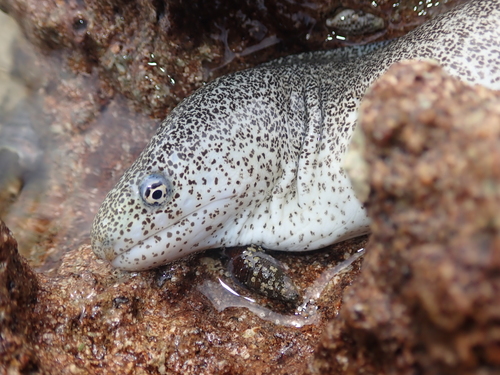
Peppered Moray
Gymnothorax pictus
A master of the shallows, the Peppered Moray is one of the few eels brave enough to hunt at the water's edge, easily recognized by its striking speckled pattern.
Quick Identification
Size
Typically grows to about 80 cm (31 in), but can reach a maximum length of 140 cm (4.6 ft).
Colors
Base color is off-white, pale grey, or light yellow, densely covered with numerous small, dark brown to black spots that resemble ground pepper.
Key Features
- Pale white or yellowish base color with fine black spotting
- Lacks pectoral and pelvic fins, typical of morays
- White to pale yellow eyes
- Often found in very shallow water, sometimes partially exposed
When You’ll See Them
Geographic range
Where Does the Peppered Moray Live?
The Peppered Moray is a widespread resident of the tropical Indo-Pacific. Its native range begins along the eastern coast of Africa and extends across the Indian Ocean to the central Pacific, reaching as far as the Hawaiian Islands and the Galápagos. They are particularly common in the waters surrounding Indonesia, the Philippines, and northern Australia, thriving in the warm, shallow intertidal zones of these volcanic and coral-rich regions.
Basemap © OpenStreetMap contributors
Behavior
The Peppered Moray is a fascinating and relatively bold species of eel known for its adaptation to shallow water environments. Unlike many of its relatives that hide in deep reef crevices, this eel is frequently found in reef flats and tide pools, where it can sometimes be seen slithering over damp rocks to move between pools during low tide. They are remarkably agile in these intertidal zones, using their muscular bodies to navigate tight spaces.
While most moray eels are strictly nocturnal, the Peppered Moray is known to be active during the day, particularly when the tide is changing. They are ambush predators that wait for prey to pass by their hiding spots, but they are also known to actively pursue crabs across the shoreline. Despite their somewhat fearsome appearance and sharp teeth, they are generally shy and will retreat into crevices when approached by humans.
EverydayEarth exclusive
Camera Tips
To capture the Peppered Moray on camera, you will need a waterproof action camera or an underwater housing. Because this species loves the intertidal zone, the best placement is inside a shallow tide pool or along the edge of a reef flat during low tide. Look for areas with high crab activity, as these are the eel's primary hunting grounds. Secure your camera to a heavy diving weight or a rock to ensure the surge of the incoming tide doesn't carry it away.
Lighting is crucial for underwater shots. Since the Peppered Moray is active during the day, try to film when the sun is at an angle—typically mid-morning or mid-afternoon—to reduce surface glare and provide enough light to penetrate the shallow water. If your camera allows, use a red filter to help balance the colors, though in very shallow water (less than 3 feet), natural light usually provides the best results without extra filters.
Set your camera to a high frame rate, such as 60 or 120 fps. The Peppered Moray is known for its lightning-fast strikes, especially when lunging out of the water at crabs on the rocks. Higher frame rates will allow you to play back these moments in slow motion, revealing the incredible mechanics of their 'second set' of pharyngeal jaws. Be sure to use a wide-angle lens setting to capture the eel's full body as it emerges from its crevice.
Similar Species
Species that look similar or are commonly confused with Peppered Moray.
Frequently Asked Questions
Record Peppered Moray at your habitat
Connect a camera to start building your own species record — AI identifies every visitor automatically.