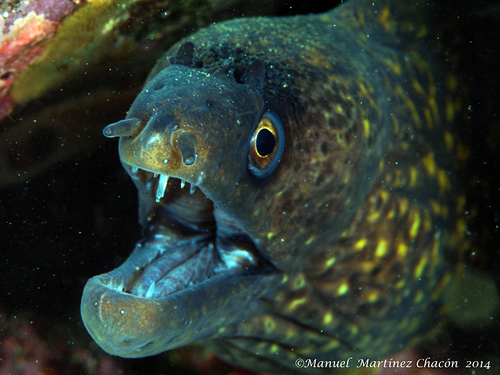
Mediterranean Moray
Muraena helena
A cryptic predator of the deep, the Mediterranean Moray fascinates with its serpent-like grace and striking marbled patterns. Often found peering from rocky crevices, this nocturnal hunter is an essential part of the Mediterranean's vibrant underwater tapestry.
Quick Identification
Size
Typically 80–150 cm (31–59 in) in length; weight up to 15 kg (33 lbs)
Colors
Dark brown, purplish, or greyish-black background with prominent yellow or white marbling and mottling
Key Features
- Serpent-like body without pectoral or pelvic fins
- Large mouth with sharp, backward-curving teeth
- Intricate white and yellow mottled pattern
- Small, circular gill openings
When You’ll See Them
Geographic range
Where Does the Mediterranean Moray Live?
Native to the temperate and subtropical waters of the Mediterranean Sea and the eastern Atlantic Ocean, the Mediterranean Moray is a cornerstone species of southern European marine ecosystems. Its core population thrives along the rocky coastlines of Italy, Greece, Spain, and Turkey, extending south to the North African shores of Morocco and Tunisia. In the Atlantic, it is commonly found around the volcanic archipelagos of the Azores, Madeira, and the Canary Islands, with its northernmost reach extending occasionally to the southern coast of the British Isles.
Basemap © OpenStreetMap contributors
Behavior
The Mediterranean Moray is a master of patience and camouflage. During the daylight hours, it is most frequently seen tucked away in rocky crevices or underwater caves with only its head protruding. It continuously opens and closes its mouth in a rhythmic fashion; while this often looks like an aggressive display to human observers, it is actually a vital respiratory function used to pump oxygenated water over its gills.
As night falls, this eel becomes an active and formidable hunter. It relies heavily on its extraordinary sense of smell to track prey in the darkness, often leaving the safety of its crevice to prowl the seabed. While solitary and territorial, they sometimes engage in symbiotic relationships with cleaner shrimp, which enter the moray's mouth to remove parasites, providing a cleaning service in exchange for protection from other predators.
EverydayEarth exclusive
Camera Tips
Capturing the Mediterranean Moray requires an underwater setup, ideally an action camera or a specialized underwater trail camera positioned near rocky reef structures. Look for 'honeycomb' rock formations or deep crevices where you can see a head poking out during the day. Secure your camera to a weighted base or a small tripod—never attach it directly to living coral or sensitive reef structures. Position the lens about 1 to 2 meters away from a suspected lair to capture the eel's full length if it emerges.
Since these eels are primarily nocturnal, external lighting is your best friend. Use a diffused red light or low-intensity wide-beam video light to avoid startling the animal. Morays have poor eyesight but an incredible sense of smell; placing a small, perforated container with oily bait like crushed sardines just out of the camera's frame can encourage the eel to fully exit its crevice for a spectacular 'full-body' shot of its undulating swimming motion.
Set your camera to video mode rather than stills. The way a Mediterranean Moray moves is its most distinct feature, and a 20-second 4K clip is far more valuable for identification and behavior study than a single photo. Be mindful of the surge and current; in shallow water, use extra diving weights to keep the camera housing perfectly still, as any wobbling will likely cause the moray to retreat into its hole. Always ensure your waterproof housing seals are lubricated and free of sand before deployment.
Similar Species
Species that look similar or are commonly confused with Mediterranean Moray.
Frequently Asked Questions
Record Mediterranean Moray at your habitat
Connect a camera to start building your own species record — AI identifies every visitor automatically.