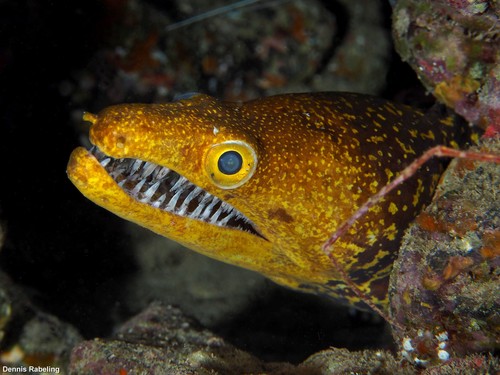
Fangtooth Moray
Enchelycore anatina
With its glass-like fangs and striking 'tiger' patterns, the Fangtooth Moray is one of the Atlantic's most visually stunning predators. This nocturnal eel turns rocky reefs into hunting grounds under the cover of darkness.
Quick Identification
Size
Typically 80–120 cm (31–47 inches) in length; weight varies but generally remains under 3 kg (6.6 lbs)
Colors
Bright yellow to golden-orange base with dark brown or black 'tiger' spots and reticulated patterns; fangs are translucent and glass-like
Key Features
- Arched jaws that prevent the mouth from closing fully
- Large, prominent glass-like fangs
- Vivid yellow skin with dark, irregular spotting
- Narrow, elongated snout with small 'bird-like' eyes
When You’ll See Them
Geographic range
Where Does the Fangtooth Moray Live?
Native to the warm volcanic waters of the eastern Atlantic Ocean, the Fangtooth Moray is most commonly found around the Macaronesian archipelagos, including the Canary Islands, Madeira, and the Azores. In recent years, it has successfully established a presence in the Mediterranean Sea, likely entering through the Strait of Gibraltar. It is now a resident in the eastern Mediterranean basin, frequently sighted off the coasts of Turkey, Greece, Sicily, and the Levantine Sea, favoring subtropical rocky coastlines.
Basemap © OpenStreetMap contributors
Behavior
The Fangtooth Moray is a reclusive predator that spends the daylight hours tucked deep within the recesses of rocky reefs. Despite its menacing appearance—caused by a jaw structure that keeps its mouth permanently agape—it is not naturally aggressive toward humans. This open-mouthed behavior is actually a respiratory necessity, as the eel must constantly pump water over its gills to breathe. In the wild, they are solitary creatures, rarely seen in groups unless a particularly high-quality crevice or abundant food source is present.
When night falls, these eels become active hunters. They rely heavily on their acute sense of smell to locate prey in the darkness, often slithering through narrow cracks in the rocks where other predators cannot reach. While they are apex predators in their micro-habitat, they are cautious of divers and will typically retreat further into their dens if they feel threatened. Interactions with humans are rare and usually limited to underwater photographers or curious snorkelers.
EverydayEarth exclusive
Camera Tips
Capturing the Fangtooth Moray requires an underwater action camera or a specialized trail camera in a waterproof housing. Because these eels are nocturnal, your camera must have high-quality infrared (IR) or low-light sensors. For the best results, mount the camera on a weighted tripod or a fixed reef clamp near the mouth of a known crevice. Look for 'cleaning stations' where small shrimp are present, as these are frequent stops for the eels.
To lure a Fangtooth Moray into the frame, use a perforated bait box or 'chum bag' filled with oily fish like sardines. Secure the bait box approximately 1–2 meters from the lens. This will encourage the eel to leave the safety of its hole, allowing you to capture its full length and distinctive 'tiger' patterns rather than just its head. Set your camera to record short video clips (15–30 seconds) triggered by motion, though be aware that swaying seaweed can cause false triggers.
Placement is everything; aim the camera at a 45-degree angle toward a rocky ledge. In the Canary Islands or Madeira, look for volcanic rock formations with holes roughly 10cm in diameter. Ensure your housing is rated for at least 10 meters of depth even if you are in the shallows, as wave pressure can be intense. Using a wide-angle lens is recommended to capture the eel's entire body if it decides to swim past the camera.
Similar Species
Species that look similar or are commonly confused with Fangtooth Moray.
Mediterranean Moray
Darker, mottled brown skin and a much sturdier jaw that can close completely.
Brown Moray
Uniform chocolate-brown color without the yellow base or tiger-like spots of the Fangtooth.
Honeycomb Moray
Found in the Indo-Pacific, featuring a white base with black honeycomb patterns rather than yellow.
Frequently Asked Questions
Record Fangtooth Moray at your habitat
Connect a camera to start building your own species record — AI identifies every visitor automatically.