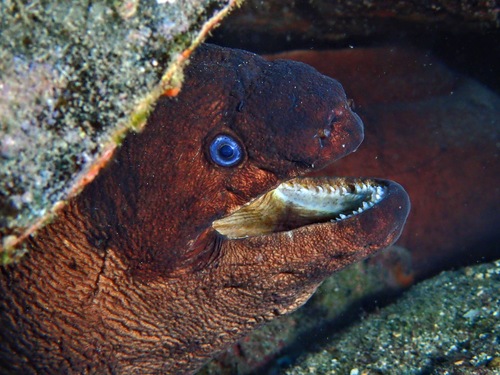
Brown Moray
Gymnothorax unicolor
A shadow among the stones, the Brown Moray is the Mediterranean's most subtle predator. With its velvet-brown skin and nocturnal grace, it rules the rocky crevices of the eastern Atlantic.
Quick Identification
Size
Typically 60–80 cm (24–31 inches), with large specimens reaching up to 100 cm (39 inches).
Colors
Uniform dark brown to reddish-brown; lacks the mottled patterns or spots found on other morays. The head may appear slightly paler than the tail.
Key Features
- Uniform chocolate brown coloration without spots
- Large, robust head with a slightly arched profile
- Single row of sharp, conical teeth
- Dark slit-like gill opening
When You’ll See Them
Geographic range
Where Does the Brown Moray Live?
The Brown Moray is a native resident of the eastern Atlantic Ocean and the Mediterranean Sea. Its core range spans from the southern coasts of Portugal and Spain through the entire Mediterranean basin, including the waters of Italy, Greece, and Turkey. It is also exceptionally common around the Macaronesian archipelagos, such as the Azores, Madeira, and the Canary Islands, extending down the African coastline as far south as Senegal.
Basemap © OpenStreetMap contributors
Behavior
The Brown Moray is a solitary and secretive predator that spends the daylight hours tucked deep within the rocky crevices of Mediterranean and Atlantic reefs. Unlike some of its more aggressive cousins, it is generally shy and will retreat further into its hole when approached by divers. However, it is highly territorial regarding its specific crevice and will defend its home if an intruder gets too close.
As a nocturnal specialist, this eel emerges under the cover of darkness to hunt. It relies heavily on its highly developed sense of smell (chemoreception) to navigate the pitch-black seafloor, as its eyesight is relatively poor. You will often see it rhythmically opening and closing its mouth; while this can look intimidating to humans, it is actually a vital respiratory action to pump water over its gills.
EverydayEarth exclusive
Camera Tips
Capturing a Brown Moray on camera requires a waterproof setup, such as an action camera in a dive housing or a specialized underwater trail camera. For the best results, mount your camera on a weighted tripod or a heavy plate to ensure it stays stationary on the seabed. Position the lens about 12 to 18 inches away from a known 'eel hole'—look for rocky crevices with clear space in front of them where an eel might emerge to hunt.
Because the Brown Moray is strictly nocturnal, external lighting is your biggest challenge. Standard camera flashes often wash out the subject or startle the wildlife. Instead, use a diffused underwater video light with a 'red light' mode if possible; many marine creatures, including morays, are less sensitive to red spectrum light, allowing you to capture natural foraging behavior without causing distress.
Baiting is an effective way to draw a Brown Moray into the frame, but it must be done responsibly. Place a mesh 'scent bag' filled with oily fish like sardines or mackerel just inside the camera's field of view. Secure the bag firmly to a rock so the eel cannot swim away with it. This will encourage the eel to linger in front of the lens as it investigates the source of the scent.
Set your camera to record short video clips (15-30 seconds) rather than still photos. Moray eels move with a beautiful, serpentine undulation that is much more impressive in motion than in a static image. Ensure your housing is rated for at least 20 meters of depth to prevent leaks, and always double-check the O-ring seals for sand or hair before deployment.
Similar Species
Species that look similar or are commonly confused with Brown Moray.
Mediterranean Moray
Has a distinct yellow-and-black marbled pattern, whereas the Brown Moray is a solid, uniform color.
Goldentail Moray
Much smaller with fine yellow spotting across the body and a bright yellow tail tip.
Purplemouth Moray
Features a purplish tint inside the mouth and a more mottled, darker body coloration.
Frequently Asked Questions
Record Brown Moray at your habitat
Connect a camera to start building your own species record — AI identifies every visitor automatically.