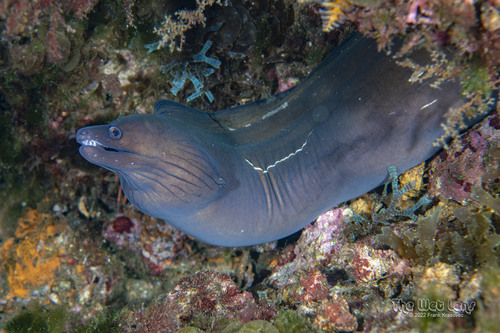
Purplemouth Moray
Gymnothorax vicinus
A master of the reef's shadows, the Purplemouth Moray is a striking nocturnal predator known for its mottled golden skin and secretive nature.
Quick Identification
Size
Typically 60-100 cm (2-3.3 ft), reaching a maximum length of 122 cm (4 ft). They generally weigh between 1.5-3 kg (3.3-6.6 lbs).
Colors
Mottled yellowish-brown to dark brown body with intricate pale spots; the most distinctive feature is the dark purple or brownish-black lining inside the mouth.
Key Features
- Dark purple or near-black interior of the mouth
- Mottled yellowish-brown pattern across the body
- Golden-yellow eyes with dark pupils
- Absence of pectoral and pelvic fins
- Sharp, backward-curving teeth visible when gaping
When You’ll See Them
Geographic range
Where Does the Purplemouth Moray Live?
The Purplemouth Moray is a staple of the Atlantic Ocean's tropical and subtropical zones. Its range extends from the North American coast near North Carolina down through the Florida Keys, the Gulf of Mexico, and throughout the Caribbean Sea to Brazil. Across the Atlantic, it is also frequently recorded near the Azores, Cape Verde, and the coast of West Africa, thriving in shallow reef systems usually no deeper than 50 meters.
Basemap © OpenStreetMap contributors
Behavior
The Purplemouth Moray is a reclusive, primarily nocturnal predator that spends its daylight hours tucked away in the deep crevices of coral reefs or rocky outcrops. While often seen 'gaping'—opening and closing its mouth repeatedly—this is not a sign of aggression; rather, it is a necessary respiratory action to pump oxygen-rich water over its gills. They are solitary creatures that maintain a home range within the reef structure.
Despite their somewhat menacing appearance and sharp teeth, they are generally shy toward humans unless provoked or accidentally cornered. In the wild, they exhibit a fascinating 'knotting' behavior, where they twist their bodies into a loop to gain leverage while tearing apart larger prey. They have been known to engage in cooperative hunting with certain grouper species, a rare example of interspecies teamwork in the ocean.
EverydayEarth exclusive
Camera Tips
Capturing a Purplemouth Moray requires an underwater camera setup, ideally one mounted near a known 'cleaning station' or a high-relief rocky crevice. Because they are nocturnal, use a camera with high-quality Infrared (IR) capabilities or a motion-activated underwater light. Position the camera at a slight upward angle near the base of a reef ledge to capture the eel as it emerges from its den to hunt.
Standard trail cameras won't work underwater without a specialized dive housing. For coastal 'backyard' enthusiasts with docks or private sea walls, a weighted drop-camera system works best. Ensure the camera is secured with a tether to prevent it from being moved by currents or curious marine life. Setting the trigger interval to the shortest possible time is crucial, as eels can move surprisingly fast when they strike.
If you are filming in a tidal area, time your captures with the incoming high tide at night, which is when these eels are most active in the shallows. Avoid using bright white lights for extended periods, as this can spook the eel or attract unwanted swarms of small baitfish that may obscure the lens. Instead, use red light or low-intensity IR to capture natural foraging behaviors without disturbing the animal.
Similar Species
Species that look similar or are commonly confused with Purplemouth Moray.
Frequently Asked Questions
Record Purplemouth Moray at your habitat
Connect a camera to start building your own species record — AI identifies every visitor automatically.