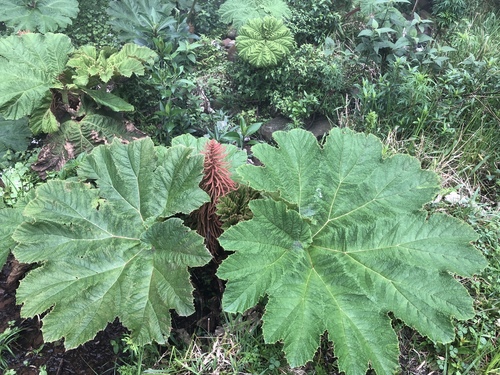
giant rhubarb
Gunnera manicata
A prehistoric giant that turns any backyard into a scene from the Jurassic era. Known for its massive leaves and architectural presence, this South American native is a master of nitrogen-fixation and a haven for moisture-loving wildlife.
Quick Identification
Size
Height up to 2.5–3 metres (8–10 feet); leaves can reach 2 metres (6.5 feet) in diameter
Colors
Deep green leaves with prominent pale veins; reddish-brown bristly stems; cone-like reddish-green flower spikes
Key Features
- Massive umbrella-like leaves with serrated edges
- Thick, fleshy stems covered in reddish prickles
- Gigantic conical flower spikes (inflorescences)
- Rhizomatous crown that looks like a hairy mound in winter
When You’ll See Them
Geographic range
Where Does the giant rhubarb Live?
The giant rhubarb is native to the South American continent, specifically originating from the high-altitude, humid slopes of the Serra do Mar Mountains in Southern Brazil. It is most commonly found in the wild within the states of Santa Catarina, Paraná, and Rio Grande do Sul. Due to its dramatic appearance, it has been widely introduced as an ornamental plant in temperate regions across Europe, North America, and New Zealand, where it thrives in moist, frost-free pockets.
Basemap © OpenStreetMap contributors
Behavior
Giant rhubarb is a herbaceous perennial known for its prehistoric appearance and staggering growth rate. During the spring, it erupts from a dormant crown, with leaves expanding at a visible pace. It is famous for its symbiotic relationship with cyanobacteria (Nostoc punctiforme) which live within its tissues; these bacteria fix nitrogen from the air, allowing the plant to reach its massive size even in nutrient-poor soils.
While it is a stationary plant, it creates a unique micro-ecosystem. The massive leaves provide dense shade and shelter for small mammals, amphibians, and insects. In many garden settings, it behaves as a 'living sculpture,' requiring significant space and constant access to water to prevent its massive foliage from wilting under the sun.
EverydayEarth exclusive
Camera Tips
Capturing the majesty of giant rhubarb requires a focus on time-lapse and scale. Because the plant grows so rapidly in early spring, set your camera to a 'Scheduled Capture' or 'Time-Lapse' mode. Taking one photo every 2-4 hours during the spring awakening will allow you to create a video showing the massive 'dinosaur food' leaves unfurling from their hairy crowns like something out of a prehistoric movie.
To emphasize the plant's size, place your camera at a low 'worm's eye view' looking upward through the forest of stems. This perspective highlights the prickly texture of the stalks and the sheer span of the leaves. If you use a trail camera with motion triggers, be aware that the massive leaves act like sails; on windy days, they will constantly trigger the camera. Set your PIR sensitivity to 'Low' or use a 'Time-Lapse only' setting during the day to avoid thousands of empty shots of moving foliage.
Because the plant creates a cool, damp microclimate, it is a magnet for wildlife. Position a camera near the base of the crown to catch frogs, toads, and small mammals seeking shelter in the shade. During the flowering season, aim your camera at the massive conical spikes to document the various pollinators, such as bees and flies, that frequent the tiny flowers. For the best lighting, avoid the midday sun which creates harsh shadows under the leaves; instead, focus your captures during the 'golden hours' of dawn and dusk when light filters through the green leaf tissue, making the entire plant glow.
Similar Species
Species that look similar or are commonly confused with giant rhubarb.
Frequently Asked Questions
Record giant rhubarb at your habitat
Connect a camera to start building your own species record — AI identifies every visitor automatically.