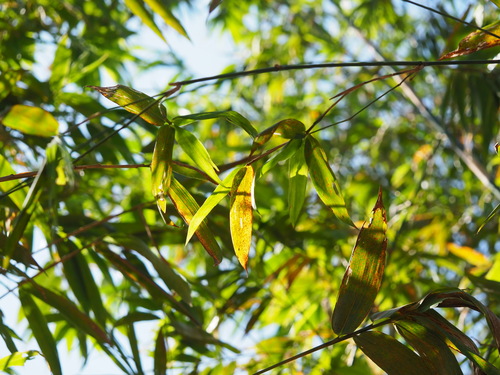
giant timber bamboo
Bambusa oldhamii
The crown jewel of clumping bamboos, Oldhamii transforms backyards into tropical cathedrals with its towering green culms and rustling canopy. It offers the ultimate natural privacy screen while serving as a vertical playground for local birds and climbing mammals.
Quick Identification
Size
Height of 50-65 feet (15-20 meters); culm diameter of 3-4 inches (7.5-10 centimeters)
Colors
Deep emerald green culms that age to a yellowish-green; new shoots covered in a silvery-white waxy powder
Key Features
- Clumping non-invasive growth habit
- Large, lance-shaped leaves up to 10 inches long
- Thick-walled, straight vertical culms
- Dense foliage starting from the mid-point of the cane
When You’ll See Them
Behavior
Giant timber bamboo, or Oldham’s bamboo, is a 'clumping' species, meaning it grows in tight, predictable circles rather than spreading aggressively via underground runners. This makes it a favorite for suburban backyards where a tall, fast-growing privacy screen is desired. Unlike 'running' bamboos, Oldhamii is well-behaved and stays where it is planted, eventually forming a massive, majestic stand of vertical canes.
As a living structure, it interacts dynamically with the environment. During the peak of summer, new shoots can emerge from the ground and reach their full height in just a few months, sometimes growing several inches in a single day. In the wind, the heavy culms sway gracefully, creating a distinctive hollow knocking sound and a rustling 'white noise' with its dense canopy. It serves as a vital micro-habitat, providing deep shade and wind protection for smaller backyard animals.
EverydayEarth exclusive
Camera Tips
To capture the true majesty of giant timber bamboo, your camera strategy should focus on two distinct phases: the explosive growth of new shoots and the wildlife that utilizes the canopy. For growth tracking, place your camera on a tripod or a low stake about 5 to 10 feet away from the base of the clump during late spring. Use a 'Time-Lapse' setting with an interval of one photo every 2-4 hours. When stitched together, this reveals the incredible 'alien' speed at which the culms emerge from the earth and rocket upward.
Because the foliage is so dense, Oldhamii is a magnet for birds seeking shelter from hawks or extreme heat. Mount your camera 5-8 feet high on a nearby fence or a sturdy outer culm, angled slightly downward into the interior 'void' of the clump. This is where small songbirds often congregate. Set your trigger sensitivity to high, as the swaying leaves can cause false triggers; you want to catch the fast movement of birds darting between the canes. Use a wide-angle lens if possible to capture the scale of the vertical culms.
For the best lighting, aim for the 'golden hour'—the hour after sunrise or before sunset. The sunlight filtering through the bamboo leaves creates a dappled effect that looks stunning on digital sensors. If you are looking for nocturnal visitors, place a camera at the base with infrared (IR) enabled. Opossums and raccoons often use the base of large bamboo clumps as a safe highway to move across yards undetected. Avoid using a heavy white flash, as the reflective waxy surface of the canes can cause significant glare in your shots.
Similar Species
Species that look similar or are commonly confused with giant timber bamboo.
Frequently Asked Questions
Record giant timber bamboo at your habitat
Connect a camera to start building your own species record — AI identifies every visitor automatically.