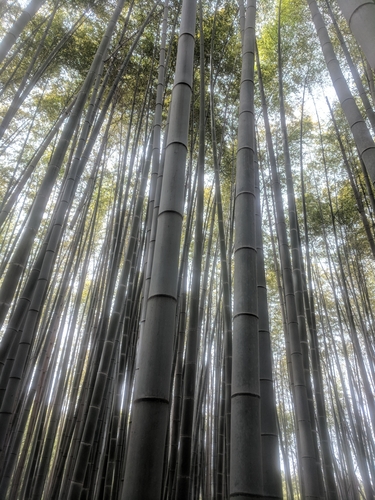
Moso Bamboo
Phyllostachys edulis
The undisputed king of temperate bamboos, Moso Bamboo creates soaring green cathedrals that can grow over three feet in a single day. It is a living marvel of nature, providing a lush, prehistoric backdrop for any backyard wildlife sanctuary.
Quick Identification
Size
Heights up to 28 meters (92 feet); culm diameters up to 18 cm (7 inches)
Colors
Young culms are bluish-green with fine velvety hairs; mature culms turn yellow-green or tan; leaves are deep emerald green.
Key Features
- Massive towering culms reaching up to 92 feet
- Velvety fine hairs on young shoots
- Thick woody stems with prominent nodes
- Lance-shaped green leaves in dense terminal clusters
When You’ll See Them
Behavior
Moso Bamboo is a powerhouse of the plant kingdom, famous for its record-breaking growth speeds. As a 'running' bamboo, it spreads through an underground network of rhizomes that can remain dormant for years before sending up massive shoots. In the peak of spring, a single shoot can grow nearly a meter in 24 hours, a phenomenon you can almost see happening in real-time. This rapid expansion creates dense, shaded groves that significantly alter the local microclimate, cooling the air and providing deep cover for various woodland creatures.
While it doesn't move like an animal, Moso Bamboo is highly interactive with its environment. It acts as a massive carbon sink and provides a vertical habitat for nesting birds and climbing insects. In a backyard or managed landscape, its 'behavior' is defined by its persistence; without proper root barriers, it will colonize new territory aggressively, seeking out moist soil and sunlight. For humans, it provides a rhythmic soundscape as the heavy culms knock against each other in the wind, creating a hollow, wooden percussion unique to giant bamboo forests.
EverydayEarth exclusive
Camera Tips
Capturing the lifecycle of Moso Bamboo on an AI-powered camera offers a unique challenge compared to tracking wildlife. To document the legendary growth of this species, the best strategy is a fixed-point time-lapse. During the spring 'shooting' season, identify a new culm just as it breaks the soil surface. Mount your camera on a heavy-duty tripod or a nearby mature culm about 5 to 10 feet away. Set your camera to take a photo every 30 to 60 minutes. Within just a week of footage, you will have a spectacular video of the bamboo 'leaping' out of the ground and telescoping toward the sky.
If you are using a motion-triggered camera to see what wildlife the bamboo attracts, placement is key. Aim your camera down the 'corridors' or paths between the culms. The dense canopy of a Moso grove creates a safe haven for birds like thrushes and towhees, as well as small mammals like rabbits or foxes looking for shade. To avoid thousands of 'false triggers' caused by the bamboo leaves swaying in the wind, set your PIR (motion) sensitivity to medium and ensure there are no leafy branches within three feet of the lens. This ensures the camera only fires when a physical body moves through the frame rather than a gust of wind.
For the best visual quality, leverage the 'Cathedral Effect.' Bamboo groves produce beautiful dappled light. Position your camera facing north or south to avoid direct lens flare from the sun, but try to catch the morning or late afternoon 'Golden Hour' rays as they filter through the high canopy. This highlights the yellow-green texture of the culms and the fine white powder often found on newer growth. If your camera records audio, the creaking sounds of the bamboo in a breeze are an essential part of the experience, so ensure the microphone is unobstructed by protective casings.
Similar Species
Species that look similar or are commonly confused with Moso Bamboo.
Frequently Asked Questions
Record Moso Bamboo at your habitat
Connect a camera to start building your own species record — AI identifies every visitor automatically.