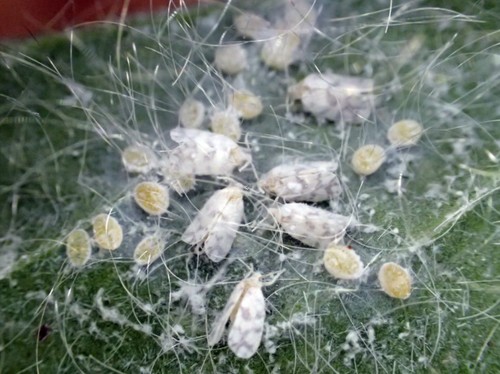
Giant Whitefly
Aleurodicus dugesii
A master of disguise and wax-work, the Giant Whitefly is an architectural marvel of the insect world. Famous for the long, silky waxy filaments its larvae produce, this tiny garden inhabitant creates miniature forests of 'hair' on the undersides of leaves.
Quick Identification
Size
Wingspan 4-5 mm (0.15-0.2 inches); body length approximately 2-3 mm (0.08-0.12 inches)
Colors
Snowy white body and wings covered in a fine waxy powder; nymphs produce long, translucent or white waxy filaments
Key Features
- Moth-like appearance with white powdery wings
- Significantly larger than common greenhouse whiteflies
- Nymphs produce dramatic, 2-inch long waxy 'hair' filaments
- Adults often congregate on the undersides of host plant leaves
When You’ll See Them
Geographic range
Where Does the Giant Whitefly Live?
The Giant Whitefly is native to Mexico but has significantly expanded its territory across North America over the last few decades. It is now a common sight in the southern United States, with established populations throughout California, Texas, Florida, and Arizona. Additionally, it has been introduced to Hawaii and several Caribbean islands, thriving in warm, frost-free environments where its host plants are abundant year-round.
Basemap © OpenStreetMap contributors
Behavior
The most striking behavior of this species is the production of 'extravagant' wax. The nymphs (immature stages) extrude long, hair-like waxy filaments that can reach several inches in length, creating a beard-like or fuzzy appearance on the host plant. While the adults are mobile and will fly in small, snowy clouds when disturbed, the nymphs remain stationary, protected by their forest of wax and the sticky honeydew they produce.
EverydayEarth exclusive
Camera Tips
Capturing the Giant Whitefly requires a macro lens or a camera with a very short focal distance, as these insects are small despite their 'giant' name. Focus your camera on the undersides of host plant leaves, specifically targeting plants like Hibiscus, Avocado, or Bird of Paradise. Look for the tell-tale 'spiral' patterns of wax and the long, hair-like filaments; these provide excellent textural contrast and are often easier for AI cameras to detect than the insects themselves.
Because these insects are most active during the day, position your camera to take advantage of bright, indirect sunlight. Direct noon sun can wash out the brilliant white of their wings, so early morning or late afternoon light often produces the best results. If using an AI-powered backyard camera, mount it on a flexible arm or tripod very close to the foliage, ensuring the wind doesn't blow the leaves out of focus, which is a common challenge with macro photography.
To capture flight behavior, you can set your camera to a high shutter speed or 'burst mode.' If you gently tap the branch, the adults will often take flight in a brief, swirling cloud before settling back down. In many regions, they are active year-round, but you will see the highest density of adults and the most dramatic wax production during the warm, dry months of late summer and early autumn.
Similar Species
Species that look similar or are commonly confused with Giant Whitefly.
Frequently Asked Questions
Record Giant Whitefly at your habitat
Connect a camera to start building your own species record — AI identifies every visitor automatically.