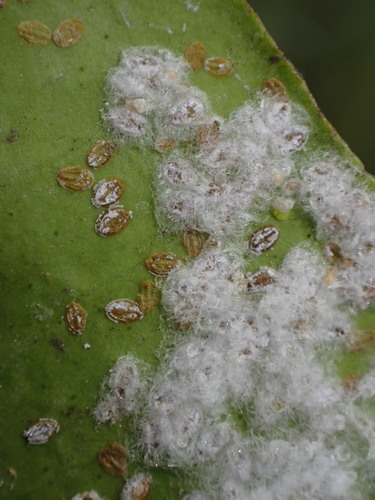
Woolly Whitefly
Aleurothrixus floccosus
The Woolly Whitefly is a master of disguise, cloaking itself in intricate waxy curls. This tiny Neotropical native has transformed citrus gardens worldwide into its own fuzzy kingdom.
Quick Identification
Size
Adults are approximately 1.5 mm (0.06 inches) long; nymphs are smaller but covered in wax filaments that can create colonies several centimeters wide.
Colors
Adults have pale yellow bodies with white, powdery wings; nymphs are yellowish-green but typically hidden under thick, white waxy 'wool'.
Key Features
- Dense, curly white waxy filaments covering the colony
- Adults hold wings in a roof-like position over the body
- Excretes sticky honeydew that attracts ants
- Found almost exclusively on the undersides of host leaves
When You’ll See Them
Geographic range
Where Does the Woolly Whitefly Live?
Originally native to the Neotropical regions of Central and South America, the Woolly Whitefly has become a globetrotting species. It is now well-established across the southern United States, particularly in California and Florida, and has spread throughout the Mediterranean Basin, parts of Africa, and into India. It thrives wherever citrus trees are cultivated in warm, frost-free climates.
Basemap © OpenStreetMap contributors
Behavior
The Woolly Whitefly is a fascinating, though often unwelcome, guest in the garden. Unlike many insects that prefer to remain solitary, these whiteflies live in crowded colonies on the undersides of leaves. The nymphs are the true architects of the colony, secreting long, curly strands of white wax that eventually form a thick, protective 'wool.' This barrier is highly effective at repelling water and shielding the vulnerable insects from small predators and parasitic wasps.
These insects are also famous for their relationship with ants. As they feed on plant sap, they excrete a sugary liquid called honeydew. Ants will actively 'farm' the whiteflies, protecting them from ladybugs and other threats in exchange for this sweet treat. To a backyard observer, the presence of sudden ant trails up a citrus tree is often the first sign of a Woolly Whitefly infestation nearby.
EverydayEarth exclusive
Camera Tips
To capture the Woolly Whitefly, you will need a dedicated macro lens or a high-quality close-up attachment for your camera. These insects are minute, so standard trail cameras may struggle to pick up detail unless they have a very short focal distance. Positioning your camera on a small tripod at the level of citrus branches is key. Aim the lens upward at the undersides of the leaves, as the 'wool' and the insects themselves rarely appear on the top surface.
Lighting is your best friend when photographing these white-clad insects. Because the 'wool' is highly reflective, direct flash can often wash out all the detail into a white blob. Instead, use off-camera lighting or a diffuser to create soft, side-lit conditions. This will highlight the individual waxy curls and the delicate structure of the adult wings. Early morning 'golden hour' light can also penetrate the leaves from behind, creating a beautiful translucent effect.
Since they don't move much in their nymph stage, you can use a slow shutter speed and a high aperture (f/11 or higher) to ensure the entire colony stays in focus. If you are trying to capture the tiny adults, look for a 'flutter' effect; they tend to fly up in a white cloud if the branch is gently shaken, which can make for a stunning high-speed capture if your camera is set to a fast burst mode.
Similar Species
Species that look similar or are commonly confused with Woolly Whitefly.
Citrus Whitefly
Lacks the characteristic thick, curly 'wool' covering in the nymph stage; nymphs are more translucent and scale-like.
Silverleaf Whitefly
Smaller and more yellow in appearance, with wings held at a steeper angle; does not produce the same dense waxy filaments.
Giant Whitefly
Significantly larger (up to 4mm) and produces very long, hair-like wax filaments that can hang down several inches from the leaf.
Frequently Asked Questions
Record Woolly Whitefly at your habitat
Connect a camera to start building your own species record — AI identifies every visitor automatically.