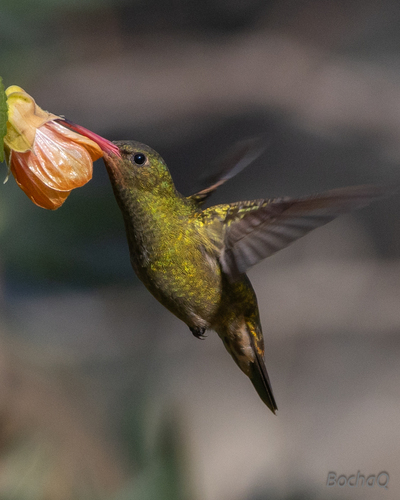
Gilded Hummingbird
Hylocharis chrysura
With its shimmering bronze-green feathers and striking coral-red bill, the Gilded Hummingbird is a jewel of South American gardens. Watch for its coppery tail as it zips between blossoms with lightning-fast agility.
Quick Identification
Size
8 to 10 cm (3.1 to 3.9 in) in length; weighs approximately 4 to 5 grams (0.14 to 0.18 oz)
Colors
Iridescent golden-green or bronzy plumage; distinct coppery-rufous tail; bright reddish-orange bill with a black tip
Key Features
- Vibrant golden-bronze iridescent body
- Bright coral-red bill with a black tip
- Distinctive coppery-gold tail feathers
- Medium-sized with a slightly curved bill
When You’ll See Them
Geographic range
Where Does the Gilded Hummingbird Live?
The Gilded Hummingbird is native to the heart of South America, primarily occupying the Southern Cone and central regions of the continent. Its core range spans across Paraguay, Uruguay, and northern Argentina, extending northward into eastern Bolivia and central-southern Brazil. As an adaptable species, it is a common resident in both the humid Atlantic Forest transitions and the drier scrublands of the interior.
Basemap © OpenStreetMap contributors
Behavior
The Gilded Hummingbird, also known as the Gilded Sapphire, is a bold and conspicuous presence in the landscapes of central South America. It is known for its territorial nature, often claiming a specific patch of flowering shrubs or a backyard feeder and aggressively defending it against other hummingbirds and even larger bird species. Between feeding bouts, it can often be seen perched on high, exposed twigs, using the vantage point to keep a watchful eye on its territory.
In flight, this species is incredibly agile, capable of hovering with precision and darting away in a flash of bronze light. While they are generally solitary outside of the breeding season, they are frequent visitors to human-inhabited areas. They are not particularly shy of humans, especially if a consistent food source like a nectar feeder is provided, making them an excellent subject for backyard observation.
EverydayEarth exclusive
Camera Tips
To capture the stunning iridescence of the Gilded Hummingbird, camera placement is everything. Position your AI-powered camera within three to five feet of a nectar source, such as a flowering Salvia plant or a red hummingbird feeder. To prevent motion blur from their rapid wingbeats, ensure your camera is set to its highest shutter speed or 'Action' mode. Since they are naturally drawn to the color red, using a red-trimmed feeder as a lure is the most effective way to ensure consistent sightings.
Lighting is the biggest challenge when photographing hummingbirds. Angle your camera so the sun is behind or to the side of the lens; direct backlighting will turn the bird into a dark silhouette, hiding its namesake golden-bronze feathers. Aim for an eye-level shot by mounting the camera on a tripod or a fence post level with the feeding ports. If your camera allows for focal zone adjustments, set it to a narrow range right at the feeding port to ensure the bird's head and bill remain in sharp focus.
Morning and late afternoon provide the best 'golden hour' light, which naturally enhances the copper tones in the bird's tail. Keep the area around the feeder clear of tall swaying grass that might trigger the motion sensor unnecessarily, but leave a few thin, bare branches nearby. Gilded Hummingbirds love to 'stake out' their territory from a high perch, and a well-placed twig just outside the feeding zone might capture a rare, high-resolution shot of the bird while it is stationary.
Similar Species
Species that look similar or are commonly confused with Gilded Hummingbird.
Frequently Asked Questions
Record Gilded Hummingbird at your habitat
Connect a camera to start building your own species record — AI identifies every visitor automatically.