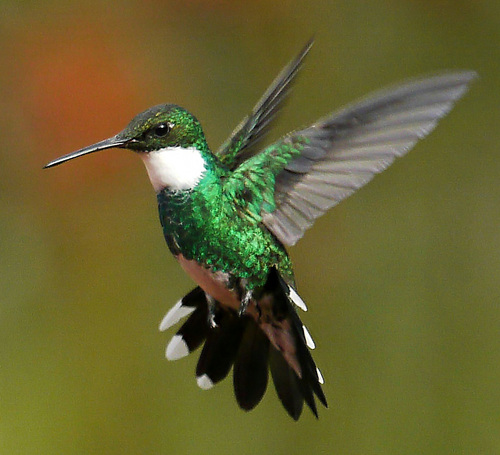
White-throated Hummingbird
Leucochloris albicollis
A shimmering jewel of the Atlantic Forest, the White-throated Hummingbird is as feisty as it is beautiful. With its crisp white bib and emerald plumage, it is a master of the air and a favorite for backyard birdwatchers.
Quick Identification
Size
Length: 10–11.5 cm (3.9–4.5 in); Weight: 6–8 g (0.21–0.28 oz)
Colors
Bright iridescent green upperparts, a brilliant pure white throat patch, white belly, and a dark tail with prominent white tips on the outer feathers. Males and females look nearly identical.
Key Features
- Large, stark white throat patch contrasting with green head
- Iridescent emerald-green crown and back
- White-tipped outer tail feathers
- Straight, medium-length black bill
- White patch on the lower belly
When You’ll See Them
Behavior
The White-throated Hummingbird is a bold and highly territorial species. Unlike some shier hummingbirds, it is well-adapted to human presence and is a frequent visitor to backyard gardens and urban parks. It is often the dominant bird at a nectar feeder, aggressively chasing away other hummingbirds and even larger birds to defend its preferred feeding spot.
In the wild, they exhibit a 'trap-lining' foraging strategy, following a regular circuit of flowering plants throughout the day. They are remarkably agile flyers, capable of hovering perfectly still while feeding and darting away at high speeds when startled or when pursuing an intruder. While mostly solitary, they can be seen in higher concentrations where food is abundant.
EverydayEarth exclusive
Camera Tips
To capture the stunning iridescence of the White-throated Hummingbird, camera placement is everything. Position your camera about 2 to 3 feet (0.6 to 1 meter) away from a nectar feeder or a cluster of tubular flowers like Salvia or Fuchsia. To get the best color from their emerald feathers, try to angle the camera so the sun is behind you, shining directly onto the bird's back and throat. If you are using an AI-powered trail cam, ensure the 'motion sensitivity' is set to high, as these birds move with incredible speed and can be gone before a slow trigger finishes firing.
Because hummingbirds have extremely fast wingbeats, video mode is often more rewarding than still photos. If your camera allows, shoot in 4K at 60fps or higher; this allows you to slow down the footage in post-production to see the mechanics of their flight. For the most natural-looking shots, try 'pre-perching' your camera. Find a small, bare twig near a food source where the bird likes to rest between feedings. Mounting your camera at eye level with this perch will result in intimate, professional-looking portraits that show off the texture of the white throat feathers.
Lighting is your best friend and worst enemy with this species. Mid-day sun can create harsh shadows and 'blow out' the white throat patch, making it look like a featureless white blob. The 'golden hours' of early morning and late afternoon provide a softer, warmer light that brings out the metallic sheen of the green plumage. If your backyard is shaded, consider a camera with a high-quality sensor that handles low light well, or place a white reflective board just out of frame to bounce a little extra light toward the bird’s throat.
Similar Species
Species that look similar or are commonly confused with White-throated Hummingbird.
Frequently Asked Questions
Record White-throated Hummingbird at your habitat
Connect a camera to start building your own species record — AI identifies every visitor automatically.