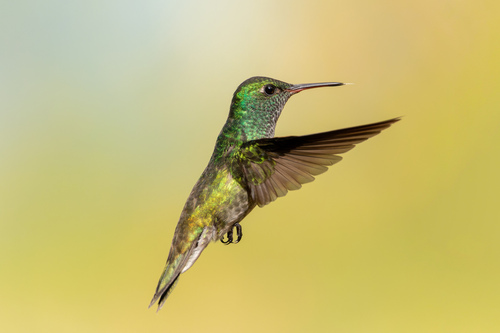
Versicolored Emerald
Chrysuronia versicolor
A shimmering gem of South American gardens, the Versicolored Emerald brings a splash of iridescent green and acrobatic energy to any backyard. These agile fliers are a favorite for birdwatchers, known for their glittering plumage and bold, territorial personality.
Quick Identification
Size
8 to 10 cm (3.1 to 3.9 inches) in length; weight ranges from 3.5 to 4.5 grams (0.12 to 0.16 oz).
Colors
Metallic emerald green upperparts and throat; males show a more brilliant glittering green or turquoise throat, while both sexes feature a distinctive white or pale grey stripe down the center of the belly.
Key Features
- Glittering green throat that shifts color in light
- Distinctive white underparts and belly stripe
- Straight bill with a reddish-pink base on the lower mandible
- Short, rounded tail with a bronze or coppery sheen
When You’ll See Them
Behavior
The Versicolored Emerald is a quintessential backyard acrobat, known for its high-energy flight and inquisitive personality. Unlike some more reclusive forest hummingbirds, this species has adapted remarkably well to human environments, frequently visiting gardens, parks, and balconies. They are highly territorial over prime nectar sources and can often be seen engaging in high-speed aerial dogfights with other hummingbirds to defend a favorite flowering bush.
When not defending their turf, these birds exhibit a fascinating foraging strategy called 'trap-lining,' where they fly a regular route between various flowering plants. They are also adept 'flycatchers,' frequently seen darting into the air to snatch tiny gnats or spiders. Their social interactions are mostly limited to brief, intense encounters during the breeding season, as they are primarily solitary creatures that spend most of their day alternating between intense feeding bursts and quiet perching to conserve energy.
EverydayEarth exclusive
Camera Tips
To capture the stunning iridescence of the Versicolored Emerald, camera placement is critical. Position your AI-powered camera within 18 to 36 inches of a dedicated hummingbird feeder or a cluster of tubular flowers like Salvia, Bromeliads, or Hibiscus. Because these birds are incredibly fast, ensure your camera is set to its highest shutter speed or 'Burst Mode' to freeze the action of their wings, which can beat up to 80 times per second. Mounting the camera at a height of 4 to 5 feet will give you the best eye-level perspective of their hovering behavior.
Lighting is the most important factor for highlighting their name-sake 'versicolor' plumage. To see the throat shift from deep green to brilliant turquoise, the sun should be behind the camera and shining directly onto the bird's front. If the bird is backlit, it will appear as a dark silhouette. Early morning light provides a golden glow that makes the metallic feathers pop, while midday sun can sometimes be too harsh and wash out the subtle color transitions.
Look for 'perch points' to get high-quality resting shots. These hummingbirds often have a favorite thin twig or wire near a food source where they sit to survey their territory. If you spot a bird returning to the same branch, aim your camera there. This is often the best way to get a clear, focused shot of the reddish base of their bill and the intricate scale-like patterns of their feathers without the blur of flight. If using a lure, a bright red feeder with a 1:4 sugar-to-water ratio is the gold standard for attracting them to your lens.
Similar Species
Species that look similar or are commonly confused with Versicolored Emerald.
Glittering-bellied Emerald
The Glittering-bellied has a more solid green belly and a more vibrantly orange/red bill compared to the Versicolored's white belly stripe.
White-throated Hummingbird
The White-throated has a much more prominent, solid white patch on the throat, whereas the Versicolored has a glittering green throat with white lower underparts.
Sapphire-spangled Emerald
This species features a blue-spangled throat rather than the predominantly green or turquoise throat of the Versicolored Emerald.
Frequently Asked Questions
Record Versicolored Emerald at your habitat
Connect a camera to start building your own species record — AI identifies every visitor automatically.