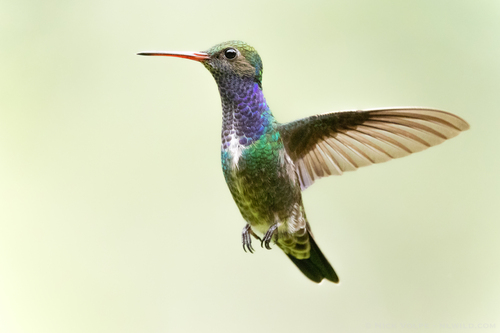
Sapphire-spangled Emerald
Chionomesa lactea
With a throat like a precious gem and a bold personality to match, the Sapphire-spangled Emerald is the crown jewel of the South American backyard. Its striking white racing stripe and shimmering blue plumage make it an unmistakable and delightful visitor for any camera enthusiast.
Quick Identification
Size
Length of 8.5–11 cm (3.3–4.3 in); Weight approximately 4–5 g (0.14–0.18 oz)
Colors
Metallic golden-green upperparts; males feature a brilliant sapphire-blue to violet throat and breast; both sexes have a distinctive white vertical stripe down the center of the underparts.
Key Features
- Glittering sapphire-blue throat and upper chest in males
- Broad white stripe running down the center of the breast and belly
- Straight black bill with a pinkish-red base on the lower mandible
- Deeply forked, dark steel-blue tail
When You’ll See Them
Behavior
The Sapphire-spangled Emerald is a bold and highly active hummingbird known for its adaptability to human-altered landscapes. While many forest birds retreat from development, this species often thrives in suburban gardens and city parks across its South American range. They are moderately territorial and will vigorously defend a rich nectar source from other hummingbirds, though they are also known to 'trap-line,' flying a regular circuit between widely dispersed flowering plants.
In the backyard setting, they are inquisitive and may hover just a few feet away from humans to inspect a new feeder or a brightly colored piece of clothing. Their flight is characterized by rapid, jerky movements and a soft humming sound produced by their wings. During the breeding season, males perform subtle aerial displays to attract females, often singing a thin, high-pitched melody from a high, exposed perch.
EverydayEarth exclusive
Camera Tips
To capture the stunning iridescence of the Sapphire-spangled Emerald, camera placement is everything. Position your camera approximately 3 to 5 feet away from a nectar feeder or a cluster of tubular flowers like Salvia or Hibiscus. Since these birds are small and move with incredible speed, aim the lens at a 45-degree angle to the light source. Direct front-lighting can wash out the colors, while side-lighting or 'golden hour' sun will make that sapphire throat patch truly glow on camera.
Because hummingbirds move faster than the human eye can track, standard motion triggers can sometimes be too slow, resulting in a 'ghost' or a tail-only shot. If your AI camera allows for pre-trigger recording or high-speed 'burst' modes, enable them. A shutter speed of at least 1/2000th of a second is necessary to freeze the wing motion, though many backyard observers prefer a slightly slower speed (around 1/1000th) to maintain a soft blur on the wingtips, which conveys a sense of movement.
If you are using a trail camera with video capabilities, set the resolution to the highest possible (4K if available) and the frame rate to at least 60fps. This allows you to play back the footage in slow motion, revealing the intricate mechanics of their hovering flight. To keep the bird in the frame longer, provide a small, thin 'perch' branch about 12 inches away from the food source; they will often land there to survey the area before and after feeding, giving your camera time to lock focus and capture a still portrait.
Similar Species
Species that look similar or are commonly confused with Sapphire-spangled Emerald.
Glittering-bellied Emerald
Lacks the white belly stripe and has a more curved, orange-based bill.
Versicolored Emerald
The white on the underparts is more diffused and the throat is typically green or turquoise rather than deep sapphire blue.
White-chested Emerald
Has a completely white chest and throat, lacking the brilliant blue spangles.
Frequently Asked Questions
Record Sapphire-spangled Emerald at your habitat
Connect a camera to start building your own species record — AI identifies every visitor automatically.