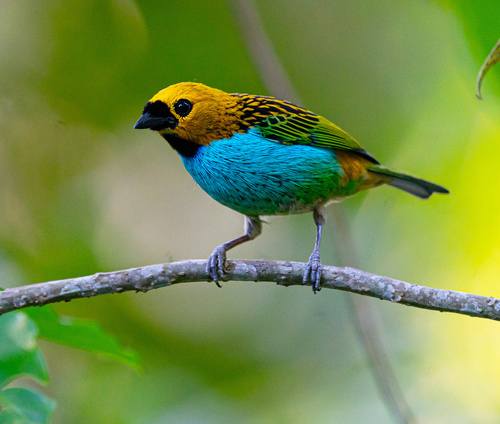
Gilt-edged Tanager
Tangara cyanoventris
A shimmering jewel of the Brazilian Atlantic Forest, the Gilt-edged Tanager captivates with its brilliant golden plumage and vibrant turquoise underparts. This endemic beauty is a testament to the rich biodiversity found in Brazil's coastal woodlands and suburban garden edges.
Quick Identification
Size
13–14 cm (5.1–5.5 inches); Weight 17–20g (0.6–0.7 oz)
Colors
Brilliant golden-yellow head and neck; turquoise-blue breast and belly; black mantle with feathers broadly edged in golden-yellow; black face mask.
Key Features
- Striking golden-yellow head and neck
- Black throat and facial mask
- Bright turquoise-blue underparts
- Black back feathers with prominent gold edges
When You’ll See Them
Geographic range
Where Does the Gilt-edged Tanager Live?
This stunning bird is a South American treasure, found exclusively within the borders of Brazil. It inhabits the lush Atlantic Forest biome, stretching from the state of Bahia in the north down through Minas Gerais, Espírito Santo, and Rio de Janeiro, reaching as far south as São Paulo and occasionally Rio Grande do Sul. For birdwatchers and nature enthusiasts, this core range represents one of the most biodiverse regions on the continent, where the Gilt-edged Tanager remains a year-round resident.
Basemap © OpenStreetMap contributors
Behavior
The Gilt-edged Tanager is a highly active and social songbird, typically found moving through the middle and upper canopies of the Atlantic Forest. They are rarely seen alone, usually traveling in small family groups or joining larger mixed-species foraging flocks alongside other tanagers, honeycreepers, and wood-warblers. This social nature makes them a delight to observe, as one sighting often leads to many more.
When foraging, they exhibit a restless energy, hopping quickly between branches to glean insects from leaves or to pluck small ripe fruits. While they are primarily forest-dwellers, they have shown a remarkable ability to adapt to human-altered landscapes, often visiting suburban gardens and orchards near forest fragments, especially when fruit trees are in season. They are not particularly shy, allowing for relatively close observation if the observer remains still.
EverydayEarth exclusive
Camera Tips
To capture the Gilt-edged Tanager on your backyard camera, focus on the 'edge effect.' Place your camera near the transition between dense shrubbery and open spaces, or near native fruiting trees. Since they prefer the mid-canopy, mount your camera slightly higher than usual—about 5 to 7 feet up—angling it slightly downward toward a sturdy branch or a specialized bird platform feeder. A high-resolution setting is essential to capture the intricate golden 'gilt' on their black back feathers.
Attracting them to a specific spot is best achieved using fruit. They are particularly fond of overripe bananas, papayas, and oranges. Secure the fruit to a branch or a flat platform within the camera’s focal range to prevent larger animals from dragging it away. Because they are fast-moving, use a camera with a high trigger speed (under 0.3 seconds) and a multi-shot 'burst' mode. This ensures you catch the bird in a clear pose rather than just a blur of gold and blue feathers.
Lighting is your best friend with this species. Position your camera so the morning sun (6-9 AM) hits the target area from behind the camera. This 'front-lighting' will make the metallic turquoise of their belly and the gold of their head truly pop in your photos. During the drier months, a small elevated birdbath or water dripper can be an even more effective lure than food, as these birds frequently descend from the canopy to bathe and drink during the heat of the afternoon.
Similar Species
Species that look similar or are commonly confused with Gilt-edged Tanager.
Frequently Asked Questions
Record Gilt-edged Tanager at your habitat
Connect a camera to start building your own species record — AI identifies every visitor automatically.