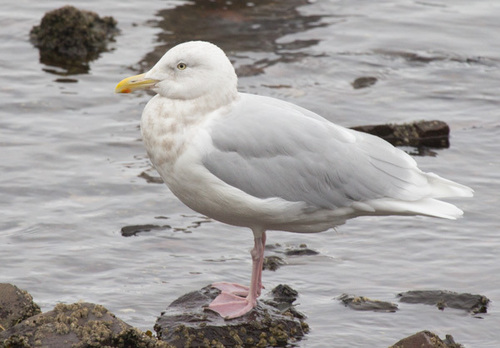
Glaucous Gull
Larus hyperboreus
The Glaucous Gull is a ghostly titan of the north, ruling the Arctic skies with its massive wingspan and distinctive lack of black wingtips. Often called the 'Burgomaster' for its commanding presence, it is a prized sighting for any backyard bird enthusiast near the coast.
Quick Identification
Size
Length: 25–30 in (64–77 cm); Wingspan: 52–67 in (132–170 cm); Weight: 2.6–5 lbs (1.2–2.3 kg)
Colors
Pale frosty gray mantle (back) with pure white flight feathers and tail; underparts are snow white; bill is heavy and yellow with a red spot; eyes are lemon yellow; legs are bubblegum pink.
Key Features
- Large size with no black markings on wingtips
- Pale gray mantle contrasting with translucent white primary feathers
- Massive yellow bill with a prominent red spot on the lower mandible
- Stocky build and relatively flat-topped head compared to other gulls
When You’ll See Them
Geographic range
Where Does the Glaucous Gull Live?
The Glaucous Gull is a true specialist of the far north, with a breeding range that spans the entire circumpolar Arctic, including the rugged coastlines of Northern Canada, Alaska, Greenland, Iceland, and Northern Russia. As the winter ice packs expand, these birds migrate south to more temperate regions, frequently appearing along the shores of the northern United States, the British Isles, and the coasts of Japan and China. While they are primarily coastal, they are also found inland around major water systems like the Great Lakes during the coldest months of the year.
Basemap © OpenStreetMap contributors
Behavior
During the winter months, these gulls move southward, though they remain solitary or associate in small numbers with larger flocks of Herring Gulls. While they are naturally wary of human presence in their remote breeding grounds, they can become remarkably bold in wintering areas like fishing harbors or landfills, where they use their sheer size to secure the best feeding spots. They are powerful, soaring flyers that spend hours on the wing patrolling the shoreline for opportunistic meals.
EverydayEarth exclusive
Camera Tips
To capture the Glaucous Gull on an AI-powered camera, placement is everything. These birds are attracted to high-activity coastal areas or places with high vantage points. If you are setting up near a beach or large lake, mount your camera on a sturdy post or a large piece of driftwood facing the water. Because they have a massive wingspan, you should position the camera at least 10-15 feet away from where you expect them to land to ensure the entire bird remains in the frame during flight or wing-stretching displays.
Using bait is an effective way to bring these gulls within camera range. Large fish scraps or whole oily fish like mackerel are irresistible to them. Secure the bait to a flat rock or a patch of sand using a small stake to prevent the gull from simply flying off with it immediately. This forces the bird to stay in front of the lens while it feeds, giving your camera plenty of time to capture high-quality images and videos. Since these birds are very large and bright, they can easily cause 'white-out' on many digital sensors; try to angle your camera so it is not facing the direct sun, which will help preserve the detail in their white plumage.
During the winter, when these gulls are most likely to visit southern latitudes, set your camera to a high-sensitivity trigger. Glaucous Gulls often move in quickly when they spot food, and you don't want to miss the initial landing. If your camera has a 'burst' mode or high-frame-rate video setting, use it—this is the best way to capture the impressive sight of their translucent white wingtips. Early morning light is particularly flattering for this species, as it highlights the subtle 'glaucous' gray of their back without the harsh glare of midday.
Similar Species
Species that look similar or are commonly confused with Glaucous Gull.
Frequently Asked Questions
Record Glaucous Gull at your habitat
Connect a camera to start building your own species record — AI identifies every visitor automatically.