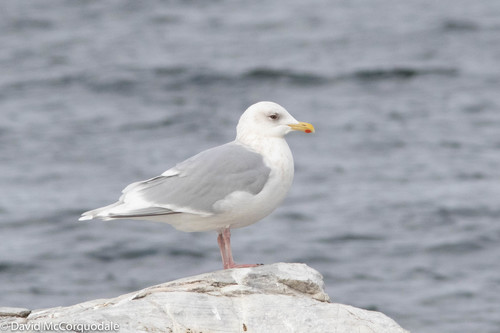
Iceland Gull
Larus glaucoides
A delicate 'ghost' of the Arctic, the Iceland Gull is a winter visitor famous for its striking white wingtips and surprisingly gentle appearance compared to its rowdier cousins.
Quick Identification
Size
Length 50–64 cm (20–25 in); Wingspan 115–145 cm (45–57 in); Weight 600–1,100 g (1.3–2.4 lb)
Colors
Adults are very pale with light gray upperparts and pure white underparts. Juveniles are creamy-buff or 'biscuit' colored with intricate marbling.
Key Features
- White or very pale gray wingtips (lacks black ink-spots)
- Small, rounded head with a 'gentle' facial expression
- Short, slender bill compared to other large gulls
- Primary feathers extend significantly past the tail at rest
When You’ll See Them
Geographic range
Where Does the Iceland Gull Live?
The Iceland Gull is an Arctic specialist native to the northern reaches of North America and Greenland. Despite its name, it breeds exclusively on the rocky cliffs of the Canadian Arctic and Greenland, rather than Iceland itself. During the winter, it migrates south to the coastal regions of the northern United States, the United Kingdom, and Scandinavia, with a significant wintering population finally reaching the shores of Iceland.
Basemap © OpenStreetMap contributors
Behavior
Iceland Gulls are known for their buoyant and elegant flight, often appearing lighter and more graceful in the air than the similar Herring Gull. They are social birds, frequently found in mixed flocks with other gull species at roosting sites or feeding grounds. While they breed in remote Arctic colonies, they become familiar sights in harbors and coastal towns during the winter months.
Unlike some of the more aggressive large gulls, Iceland Gulls are relatively shy and may wait on the edges of a feeding frenzy for scraps. They are highly opportunistic, often following fishing boats or scanning the water's surface for small fish. In urban and suburban wintering areas, they are increasingly seen at reservoirs and large parking lots, where they rest between feeding bouts.
EverydayEarth exclusive
Camera Tips
To successfully capture an Iceland Gull on camera, focus on coastal or lakeside locations during the coldest months of the year. Place your camera on a low tripod or mount it near the ground (about 12–18 inches high) at a beach or pier edge where gulls are known to congregate. Because these birds are smaller and have a more delicate structure than Herring Gulls, a lower angle helps emphasize their unique profile and 'gentle' facial expression.
If you are using a camera in a backyard near a large body of water, a flat platform feeder or even a clear patch of ground can work. While they don't typically visit hanging feeders, they may be attracted to suet or fish scraps placed on a high-visibility surface. Ensure your camera is positioned to catch the light from behind you; the Iceland Gull's pale plumage can easily 'blow out' and lose detail in harsh, direct sunlight or glare off the snow.
Settings are crucial for this species. Use a fast shutter speed or high-sensitivity trigger to capture their buoyant flight. If your camera allows for it, adjust the exposure compensation down slightly to preserve the detail in their white wingtips, which are their most important identification feature. Winter storms often push these birds inland, so keep your camera active and batteries fresh during snowy or overcast weather when these 'ghost' gulls are most likely to appear.
Similar Species
Species that look similar or are commonly confused with Iceland Gull.
Frequently Asked Questions
Record Iceland Gull at your habitat
Connect a camera to start building your own species record — AI identifies every visitor automatically.