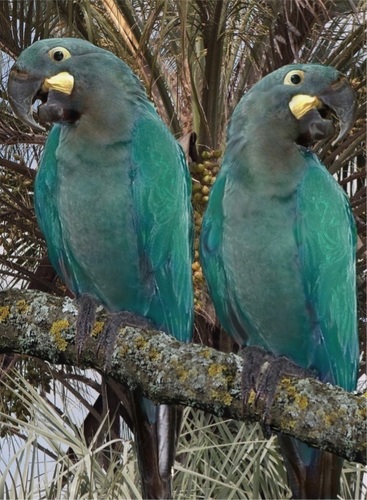
Glaucous Macaw
Anodorhynchus glaucus
A turquoise ghost of the South American rivers, the Glaucous Macaw is a majestic parrot that remains one of the world's most sought-after 'lost' species.
Quick Identification
Size
70 cm (27.5 in) in length; wingspan approximately 95-105 cm (37-41 in); weight 800-1,000 g (1.75-2.2 lbs)
Colors
Pale turquoise-blue body plumage with a greyish-green cast; heavy greyish-blue head; bright yellow orbital ring and a yellow crescent at the base of the lower mandible
Key Features
- Large, heavy bill with yellow skin at the base
- Pale turquoise-blue plumage with a greyish-green tint
- Distinctive pale grey head
- Yellow eye-rings and crescent at the base of the lower mandible
When You’ll See Them
Geographic range
Where Does the Glaucous Macaw Live?
The Glaucous Macaw is native to the subtropical interior of South America, historically centered around the middle reaches of the Uruguay, Paraguay, and Paraná rivers. Its core range once spanned across northeastern Argentina, southern Brazil, northeastern Paraguay, and northwestern Uruguay. Today, the species is feared extinct, as no confirmed wild populations have been documented in these regions for over half a century.
Basemap © OpenStreetMap contributors
Behavior
The Glaucous Macaw was historically a highly social and vocal bird, typical of the large South American macaws. They were usually observed in pairs or small family groups, communicating with loud, raucous calls while traversing the sky between their roosting sites and feeding grounds. In the Guarani language, they are known as 'gua'a hovy', a name that phonetically mimics their resonant vocalizations.
These macaws were extreme specialists, centering their entire lives around riverine environments and specific palm groves. They were known to nest in the crevices of limestone cliffs along major river banks, though they may have also used large tree hollows. Much of their day was spent foraging for palm nuts, using their powerful beaks to manipulate and crack open incredibly hard seeds that other animals could not access.
Interaction with humans proved devastating for the species. During the 19th century, they were frequently trapped for the live bird trade and suffered from the widespread clearing of the Yatay palm groves for cattle ranching. While not naturally aggressive, their dependence on very specific habitats made them highly vulnerable to environmental changes, leading to their current status as one of the world's greatest ornithological mysteries.
EverydayEarth exclusive
Camera Tips
Attempting to capture a Glaucous Macaw on camera today is more of a conservation mission than a hobby, as the bird is potentially extinct. To have any chance of success, your trail cameras should be deployed in the remaining old-growth Yatay palm groves in northeastern Argentina or southern Paraguay. These birds are dietary specialists, so focusing your lens on a cluster of fruiting palms is the most effective way to monitor for their presence. Use a wide-angle lens setting to cover the entire canopy of a palm stand.
Mount your cameras high—ideally 15 to 20 feet up a sturdy trunk—to get a clear view of the upper branches where macaws prefer to land. If you are monitoring river cliffs, position your camera at the top of the cliff facing downward toward potential nesting crevices. Because macaws are highly intelligent and observant, ensure your camera housing is well-camouflaged with local moss or bark to avoid scaring off any wary survivors.
Set your camera to capture high-definition video with a long duration (at least 30 seconds) and a very fast trigger speed. Macaws move quickly when they land and begin feeding, and the extra video footage is crucial for distinguishing this species from the similar Lear's Macaw. Use a high shutter speed for daytime photos to ensure the turquoise-blue feathers don't blur in the bright South American sun.
The best time for capture is during the 'golden hours' of shortly after sunrise and just before sunset, when macaws are most active in transit. Ensure your camera's PIR sensor sensitivity is set to high to detect movement at a distance, as these birds may not land directly in front of your setup. Avoid using any artificial baits other than the natural presence of palm nuts, as these birds are extremely specialized and unlikely to visit traditional bird feeders.
Similar Species
Species that look similar or are commonly confused with Glaucous Macaw.
Frequently Asked Questions
Record Glaucous Macaw at your habitat
Connect a camera to start building your own species record — AI identifies every visitor automatically.