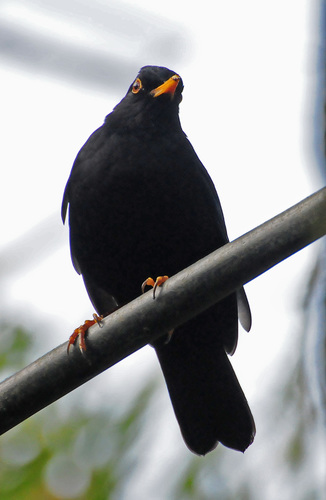
Glossy-black Thrush
Turdus serranus
The Glossy-black Thrush is the 'midnight' songster of the Andes, recognizable by its jet-black plumage and glowing orange eye-ring. A master of the cloud forest melody, this bird brings a touch of elegance to high-altitude gardens.
Quick Identification
Size
23–25 cm (9–10 inches) in length; weighs approximately 70–90 grams (2.5–3.2 oz)
Colors
Males are uniform glossy black with a bright yellow to orange bill and eye-ring. Females are olive-brown above and slightly paler brown below.
Key Features
- Solid glossy black plumage in males
- Bright orange-yellow bill and fleshy eye-ring
- Uniformly brown/olive-brown plumage in females
- Thickset thrush-like build with a relatively long tail
When You’ll See Them
Geographic range
Where Does the Glossy-black Thrush Live?
The Glossy-black Thrush is native to the South American continent, primarily inhabiting the rugged corridors of the Andes Mountains. Its range extends from the coastal mountains of Venezuela and Colombia, south through the highlands of Ecuador, Peru, and Bolivia, finally reaching its southern limit in northwestern Argentina. This species is a highland specialist, thriving in the moist, temperate climates of the mountain interior.
Basemap © OpenStreetMap contributors
Behavior
The Glossy-black Thrush is a quintessential songbird of the Andean cloud forests, known for its hauntingly beautiful, flute-like song. While they are often heard echoing through the mist during the dawn and dusk choruses, they can be somewhat retiring. They spend much of their time in the sub-canopy or mid-story of the forest, though they frequently descend to the ground to forage in the leaf litter.
Unlike some of the more aggressive urban thrushes, this species tends to be solitary or found in pairs. They are cautious but can become accustomed to human presence in quiet suburban gardens that border natural forest. During the breeding season, males become highly territorial of their song perches, often choosing the highest available branch to project their melodies across the mountain slopes.
EverydayEarth exclusive
Camera Tips
To successfully capture a Glossy-black Thrush on camera, focus on ground-level or low-elevation placement. These birds are frequent ground foragers, so mounting your camera about 12 to 18 inches off the ground near a patch of damp leaf litter or a mossy log is ideal. Because they are often found in the deep shade of the forest understory, ensure your camera has a high-quality sensor that performs well in low-light conditions to avoid grainy footage during their peak dawn and dusk activity hours.
Attracting them to a specific spot is best done with food or water. A low-profile bird bath or a shallow stone basin with trickling water is an irresistible draw for these mountain thrushes. For bait, use overripe tropical fruits like bananas, papaya, or even halved oranges placed on a flat stone or a low wooden platform. They are particularly fond of dark berries, so placing your camera near a fruiting Melastome bush can yield excellent results without the need for supplemental feeding.
Pay close attention to your camera's exposure settings. The male's solid black feathers can easily become a 'black hole' in the image if the background is too bright. Try to position the camera so the bird is backlit or in even, soft shade. If your camera supports video, set it to record 15-20 second clips; this will allow you to capture their characteristic 'tail-shiver' and their liquid, musical calls, which are just as impressive as their visual appearance.
Similar Species
Species that look similar or are commonly confused with Glossy-black Thrush.
Frequently Asked Questions
Record Glossy-black Thrush at your habitat
Connect a camera to start building your own species record — AI identifies every visitor automatically.