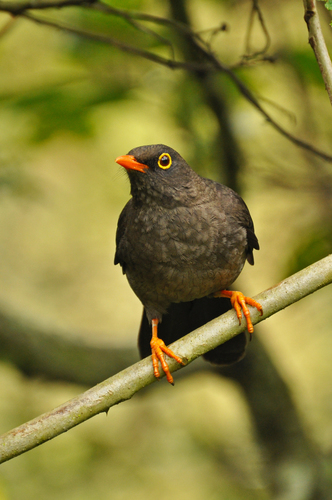
Great Thrush
Turdus fuscater
Meet the giant of the Andes' garden birds. With its striking orange bill and fearless personality, the Great Thrush is the most iconic backyard visitor in the South American highlands.
Quick Identification
Size
28–35 cm (11–14 in) in length; weighs 128–175 g (4.5–6.2 oz)
Colors
Uniform dusky slate-gray to brownish plumage; bright orange-yellow bill, legs, and a distinct fleshy eye-ring
Key Features
- Largest South American thrush species
- Bright orange-yellow bill and prominent eye-ring
- Uniform slaty-gray plumage with no chest spotting
- Long, sturdy yellow legs used for ground foraging
When You’ll See Them
Geographic range
Where Does the Great Thrush Live?
Native to the rugged landscapes of South America, the Great Thrush is a hallmark species of the tropical and subtropical Andes. Its core range stretches along the mountain spine from western Venezuela and Colombia, through the highlands of Ecuador and Peru, and down into western Bolivia. Within these regions, it thrives in high-altitude valleys and slopes, often residing in areas where other bird species struggle with the thin air, and it has successfully colonized nearly every major Andean city.
Basemap © OpenStreetMap contributors
Behavior
The Great Thrush is a bold and conspicuous presence in the Andean highlands, often seen hopping across lawns, plazas, and forest clearings with a confident, upright posture. Much like its distant relative the American Robin, it is highly adaptable to human environments and frequently becomes a familiar neighbor in suburban gardens and city parks. It is known for its loud, melodious song, which often rings out at dawn and dusk, marking its territory with a series of flute-like whistles and rhythmic chirps.
In social settings, these birds are generally solitary or found in pairs, though they may congregate where food is abundant, such as a fruiting tree. They are territorial and will vigorously defend their space from other thrushes. Their interaction with humans is relatively fearless; they often allow close approach before hopping away into nearby cover. They spend a significant amount of time on the ground, using a characteristic "run-and-stop" technique to locate prey or fallen fruit.
EverydayEarth exclusive
Camera Tips
Capturing the Great Thrush on your EverydayEarth camera requires focusing on their ground-level foraging habits. Place your camera relatively low to the ground—about 1 to 2 feet high—and angle it slightly downward towards a clear patch of lawn or leaf litter. Since they are quite large for thrushes, ensure the camera has a wide enough field of view to capture their entire profile as they hop through the frame. They are creatures of habit, so if you see one foraging in a specific spot daily, that is your primary target for a setup.
To attract them specifically, a shallow birdbath or a simple water drip is highly effective, as they are frequent and enthusiastic bathers. In terms of lures, they are drawn to softened fruits like bananas, papayas, or halved oranges placed directly on the ground or on a low platform. If you prefer a more natural approach, avoid clearing all the leaf litter in a corner of your yard; the Great Thrush will spend hours tossing leaves aside to find insects, providing excellent "action" shots for your AI-powered camera.
Because they are most active during the "blue hours" of dawn and dusk, check your camera settings to ensure it handles low-light well without excessive motion blur. High-speed shutter settings are recommended to freeze their quick, hopping movements. During the breeding season, they may also be seen carrying nesting material or mud for their cup-shaped nests, so look for repeat visits to specific shrubs or low trees to capture these unique nesting behaviors.
Similar Species
Species that look similar or are commonly confused with Great Thrush.
Glossy-black Thrush
Smaller and much darker black; lacks the Great Thrush's brownish-gray tones.
Chiguanco Thrush
Slightly smaller and paler brown with a less prominent eye-ring; typically found in drier habitats.
Black-billed Thrush
Distinguished by its dark bill and smaller size, unlike the bright orange bill of the Great Thrush.
Frequently Asked Questions
Record Great Thrush at your habitat
Connect a camera to start building your own species record — AI identifies every visitor automatically.