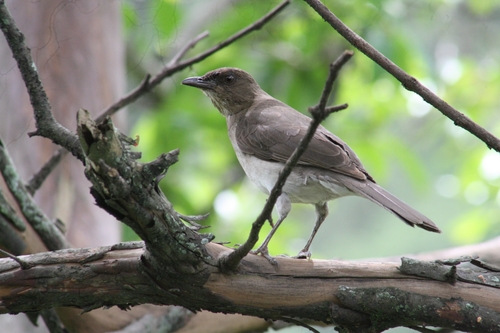
Black-billed Thrush
Turdus ignobilis
A familiar songster of South American gardens, the Black-billed Thrush is a master of suburban adaptation with a soulful voice.
Quick Identification
Size
21–24 cm (8.3–9.4 in) long; weighs approximately 55–75 g (1.9–2.6 oz)
Colors
Uniformly dull olive-brown upperparts, paler grayish-brown underparts, white throat with fine dark streaking, and a solid black bill.
Key Features
- Solid black bill without yellow or orange tones
- White throat with distinct dark vertical streaks
- Lack of a prominent eye-ring
- Dull, uniform brownish-olive plumage
- Frequent 'run-and-pause' terrestrial foraging behavior
When You’ll See Them
Geographic range
Where Does the Black-billed Thrush Live?
The Black-billed Thrush is a quintessential South American species, native to the northern and central regions of the continent. Its primary range spans the lush valleys and highlands of Colombia and Venezuela, extending southward through the Amazonian regions of Ecuador, Peru, and into northern Bolivia. It is also commonly found in northern and western Brazil, particularly where human settlements have created the open, park-like environments it prefers.
Basemap © OpenStreetMap contributors
Behavior
The Black-billed Thrush is a bold and conspicuous bird, often found living in close proximity to humans. Unlike many of its forest-dwelling relatives, this species has adapted brilliantly to urban life, where it is frequently seen hopping across lawns or singing from the rooftops of suburban homes. They are highly territorial during the breeding season and are known for their beautiful, flute-like songs that often herald the arrival of dawn and the onset of the rainy season.
In social settings, they are generally solitary or found in pairs, though they may congregate in larger numbers at fruiting trees. Their foraging style is classic for the Turdus genus: they run short distances, stop abruptly to tilt their heads and listen for subterranean prey, and then strike with precision. Because they are comfortable around people, they are one of the most likely species to be captured on backyard cameras in South American residential areas.
EverydayEarth exclusive
Camera Tips
To capture the Black-billed Thrush on camera, focus on ground-level activity. These birds spend a significant portion of their day foraging in the grass or among fallen leaves. Position your camera on a low tripod or mount it to a garden stake roughly 1 to 2 feet above the ground. Aim the lens toward a patch of moist soil or a well-watered lawn, as these are prime hunting grounds for the worms and grubs they love.
Water is a powerful attractant for this species. A ground-level birdbath or a shallow stone basin with a small dripper will almost guarantee a visit. Black-billed Thrushes are enthusiastic bathers, and the motion of splashing water is often enough to trigger the motion sensors on most AI cameras. For the best clarity, try to place the water feature in a spot that receives soft morning light, avoiding the harsh midday sun that can wash out their subtle brown plumage.
While they don't typically eat seeds, you can entice them into the frame by offering high-energy treats like chopped papaya, softened raisins, or suet pellets placed on a low platform. Since they are most active in the early morning, ensure your camera's sensitivity is high enough to capture them in the low light of dawn. Setting your camera to record 15-second video clips is ideal, as it allows you to hear their melodic calls and observe their characteristic head-cocking foraging behavior.
Similar Species
Species that look similar or are commonly confused with Black-billed Thrush.
Frequently Asked Questions
Record Black-billed Thrush at your habitat
Connect a camera to start building your own species record — AI identifies every visitor automatically.