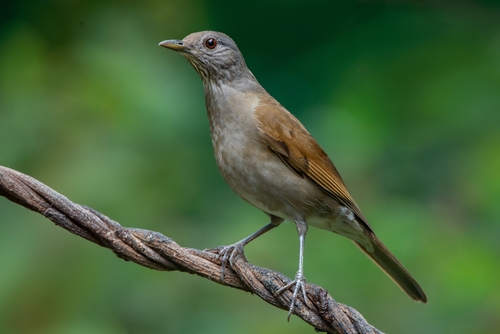
Pale-breasted Thrush
Turdus leucomelas
A master of the dawn chorus with an understated elegance, the Pale-breasted Thrush is the soulful soundtrack to South American gardens. From its white-streaked throat to its melodic flute-like song, it is a delightful frequent flyer for any backyard observer.
Quick Identification
Size
Length: 23-26 cm (9-10 in); Wingspan: 34-38 cm (13-15 in); Weight: 65-80 g (2.3-2.8 oz)
Colors
Dull olive-brown upperparts with a notably pale, grayish-white breast and belly. The throat is white with fine, dark brownish streaks. Both sexes look identical.
Key Features
- Pale grayish-white underparts contrasting with olive-brown wings
- White throat with fine vertical streaks
- Dull yellow-brown bill, often darker at the base
- Faint yellowish eye-ring and brown iris
When You’ll See Them
Behavior
The Pale-breasted Thrush is a highly adaptable and melodic songbird, frequently recognized as one of the most common avian neighbors in South American suburbs. It is famous for its flute-like, repetitive song that often marks the beginning of the dawn chorus. While they can be wary in wilder habitats, those living near humans become quite bold, often hopping across patios and lawns in search of food.
These thrushes are primarily ground-foragers, using a characteristic 'hop-and-pause' motion to listen for movement beneath the soil. They are largely solitary outside of the breeding season, though they may congregate around a particularly fruitful tree. When agitated or curious, they exhibit a quick flicking motion with their wings and tail, a classic behavioral trait of the Turdus genus.
EverydayEarth exclusive
Camera Tips
To capture the best footage of the Pale-breasted Thrush, focus your efforts on the ground. These birds spend a significant portion of their day foraging in leaf litter or on short grass. Mounting your AI camera on a low stake, roughly 12 to 18 inches above the ground, will provide an intimate, eye-level perspective of their 'hop-and-stop' hunting behavior. Position the camera near the base of a fruiting shrub or a damp patch of soil where worms are likely to surface.
Water is a massive draw for this species. Unlike some birds that prefer high-perched baths, the Pale-breasted Thrush is very comfortable using ground-level water features. A shallow birdbath or a slow-dripping misting station will almost guarantee daily visits. Ensure your camera is angled to catch the reflection in the water, and set a fast trigger speed to capture the vigorous splashing during their bathing rituals.
If you want to lure them specifically into your camera's field of view, use soft fruits as bait. Sliced bananas, overripe papayas, or halved oranges placed on a low platform or directly on a clean stone will attract them quickly. They are creatures of habit; once they discover a reliable food source, they will return at almost the exact same time every morning, allowing you to schedule your camera's high-performance recording windows.
Since they are most active during the twilight hours of dawn and dusk, low-light performance is key. If your camera has adjustable settings, ensure it is optimized for high ISO or 'Early Bird' modes. During the breeding season, keep an eye out for them carrying mud or dry grass; they often nest in the crooks of garden trees or even on man-made ledges, offering a chance to document their nesting cycle if your camera is positioned near a sheltered porch or thick hedge.
Similar Species
Species that look similar or are commonly confused with Pale-breasted Thrush.
Frequently Asked Questions
Record Pale-breasted Thrush at your habitat
Connect a camera to start building your own species record — AI identifies every visitor automatically.