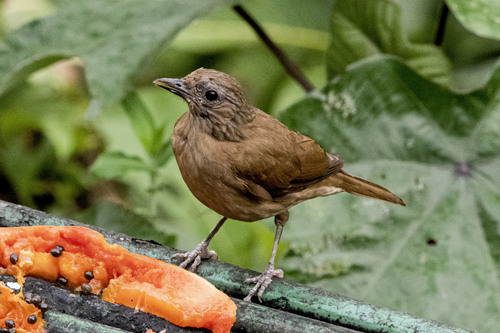
Cocoa Thrush
Turdus fumigatus
A master of the tropical shadows, the Cocoa Thrush is a secretive songbird known for its rich, earth-toned plumage and enchanting, flute-like melodies.
Quick Identification
Size
22–24 cm (8.7–9.4 in) long; weight ranges from 55–80 g (1.9–2.8 oz)
Colors
Uniform rich cocoa-brown or rufous-brown plumage; pale yellowish-brown bill; faint orange-yellow eye-ring; no white on the belly.
Key Features
- Uniform deep cocoa-brown plumage without white underparts
- Pale horn-colored or yellowish bill
- Faint orange-yellow ring around the eye
- Melodic, flute-like song typical of thrushes
When You’ll See Them
Geographic range
Where Does the Cocoa Thrush Live?
The Cocoa Thrush is a resident of South America and the southern Caribbean, primarily occupying the vast Amazon Basin and the Guiana Shield. Its native range spans across northern Brazil, Venezuela, and the Guianas, extending into eastern Colombia and reaching as far south as northern Argentina. Additionally, stable and common populations are found on the islands of Trinidad, Grenada, and St. Vincent, where they are a frequent sight in forested highlands and shaded agricultural areas.
Basemap © OpenStreetMap contributors
Behavior
The Cocoa Thrush is a secretive and primarily terrestrial songbird that thrives in the shaded understory of humid forests. Unlike the bolder American Robin, this species is quite shy, preferring to remain within the safety of dense foliage or scurrying through leaf litter on the forest floor. It moves with a characteristic hop-and-stop rhythm, often pausing to tilt its head as it listens for the movement of insects beneath the damp earth.
Socially, Cocoa Thrushes are usually observed alone or in pairs. They are highly territorial during the breeding season, which typically aligns with the arrival of the rains. Their presence is most often revealed by their beautiful, liquid song—a series of varied melodic phrases—which they deliver from mid-level perches within the canopy during the early morning and late afternoon hours. Despite their shy nature, they can become semi-tolerant of humans in quiet, well-planted tropical gardens.
EverydayEarth exclusive
Camera Tips
To successfully capture the Cocoa Thrush on your AI camera, you must think like a ground-dweller. This species spends the vast majority of its time hopping through the undergrowth, so place your camera at a low height—roughly 12 to 18 inches above the ground. Aim the lens at a flat, shaded area with plenty of leaf litter, as this is where they are most likely to forage for invertebrates.
Water is perhaps the best lure for a Cocoa Thrush. They are frequent bathers and require regular drinking water in the humid tropics. A low-profile birdbath or even a shallow, recirculating water feature placed in a dark, quiet corner of your yard will attract them far more effectively than a traditional seed feeder. Ensure the area has nearby escape cover, like low-hanging ferns or shrubs, so the bird feels safe enough to linger in front of the lens.
Because they are most active during the twilight hours of dawn and dusk, your camera's low-light capabilities are critical. If your camera allows for motion-sensitivity adjustments, set it to a high level to catch their quick, darting movements. During the rainy season, you may want to switch your camera to video mode; not only will you capture their foraging behavior, but you are also likely to record their impressive, flute-like songs which resonate beautifully in the quiet morning air.
Similar Species
Species that look similar or are commonly confused with Cocoa Thrush.
Frequently Asked Questions
Record Cocoa Thrush at your habitat
Connect a camera to start building your own species record — AI identifies every visitor automatically.