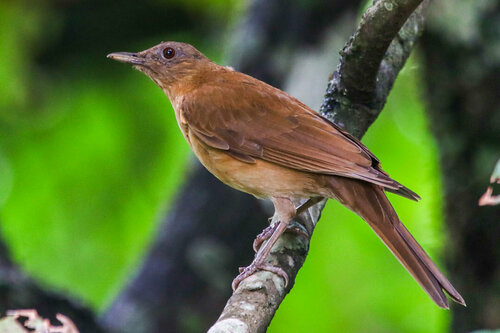
Hauxwell's Thrush
Turdus hauxwelli
A secretive songbird of the Amazonian understory, Hauxwell's Thrush is celebrated for its warm, earthy plumage and flute-like melodies. Often found following ant swarms or hopping through leaf litter, this elusive bird is a prize for any tropical wildlife watcher.
Quick Identification
Size
23–24 cm (9–9.5 inches) in length; weighs approximately 60–80 g (2.1–2.8 oz)
Colors
Overall warm olive-brown plumage; darker on the wings and tail, with a paler, buff-tinted belly and flanks. The bill is dark yellowish-brown.
Key Features
- Uniformly warm-brown underparts without heavy spotting
- Faintly streaked throat lacking a clean white patch
- Yellowish-brown bill with a darker tip
- Secretive behavior in forest undergrowth
When You’ll See Them
Geographic range
Where Does the Hauxwell's Thrush Live?
Hauxwell's Thrush is a native resident of the South American Amazon Basin. Its core range spans the tropical lowlands of northern Bolivia, western and central Brazil, eastern Peru, eastern Ecuador, and southeastern Colombia. It is a non-migratory species that remains in these lush, humid environments throughout the year.
Basemap © OpenStreetMap contributors
Behavior
Hauxwell's Thrush is a quintessential forest dweller, often heard before it is seen. Unlike the more bold garden thrushes found in urban North America, this species is relatively shy and prefers the seclusion of the tropical rainforest understory. It is primarily a terrestrial or low-level bird, spending much of its time hopping through leaf litter in search of food. While it is generally solitary or found in pairs, it may occasionally join mixed-species flocks at productive feeding sites.
In terms of social interaction, these birds are known to follow army ant swarms. As the ants move through the forest floor flushing out insects, Hauxwell's Thrush waits nearby to snatch up fleeing prey. Their song is a beautiful, flute-like series of phrases typical of the Turdus genus, often delivered from a low, hidden perch during the early morning or late afternoon when the forest is at its quietest.
EverydayEarth exclusive
Camera Tips
To capture Hauxwell's Thrush on camera, you must focus on the forest floor. This species rarely ventures high into the canopy, making a ground-level camera trap highly effective. Place your camera at a height of 12 to 18 inches (30–45 cm), pointed toward a patch of damp leaf litter or near the base of a large tree with buttress roots. These areas are prime foraging grounds where the bird searches for insects.
Water is a major draw for this species. If your property or trail area has a small forest seep or a shallow natural puddle, aim your camera there. You can also create a 'micro-habitat' by clearing a small 3-foot circle of leaves and placing a very shallow water basin inside. Adding a few mealworms or pieces of overripe tropical fruit on the ground near the water can act as a natural lure to keep the bird in the frame longer.
Because Hauxwell's Thrush prefers the deep shade of the understory, your camera needs excellent low-light performance. Use high-speed trigger settings to catch their quick hopping movements. Since they are most active at the edges of the day, ensure your camera's infrared or low-light sensor is optimized. Setting the camera to 'Video Mode' for 15-second clips is often more rewarding than still photos, as it captures their characteristic tail-flicking and foraging head-tilts.
Similar Species
Species that look similar or are commonly confused with Hauxwell's Thrush.
Pale-breasted Thrush
Has a cleaner, whiter throat and more greyish-brown tones compared to the warm, uniform brown of Hauxwell's.
Cocoa Thrush
Found in more northern regions and typically shows more distinct streaking on the throat and a brighter orange-yellow eye-ring.
Black-billed Thrush
Possesses a much darker, nearly black bill and often shows a more contrasting pale belly.
Frequently Asked Questions
Record Hauxwell's Thrush at your habitat
Connect a camera to start building your own species record — AI identifies every visitor automatically.