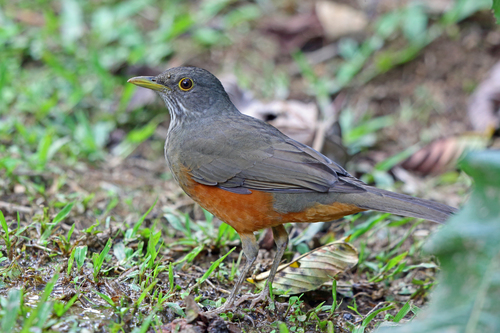
Rufous-bellied Thrush
Turdus rufiventris
The national bird of Brazil, the Rufous-bellied Thrush is a master songster with a vibrant orange belly. A common and friendly visitor to suburban gardens, it is best known for its soulful melodies that announce the break of dawn.
Quick Identification
Size
Length: 23–27 cm (9–10.6 in); Weight: 59–88 g (2.1–3.1 oz)
Colors
Olive-brown to grayish upperparts, striking rufous-orange belly, and a pale throat with fine dark vertical streaks. Bills are typically yellowish-olive.
Key Features
- Bright orange-rufous belly and underwing coverts
- Olive-brown back and wings
- Thin yellow or orange eye-ring
- Pale throat with dark brown streaks
When You’ll See Them
Behavior
The Rufous-bellied Thrush is legendary for its flute-like, melodious song, which is often the first sound heard in the South American dawn. Highly adaptable, it has transitioned seamlessly from forest edges to urban environments, becoming one of the most recognized garden birds in its range. It is a bold species that frequently interacts with human spaces, often nesting on building ledges or in backyard fruit trees.
On the ground, they move with a characteristic 'hop-and-stop' motion, tilting their heads to listen for movement beneath the soil. While they can be territorial during the breeding season—defending their space with vigor—they are generally peaceful and can be found in small, loose groups around high-value food sources like fruiting trees. Their habit of singing long before sunrise makes them a staple of the 'dawn chorus' in Brazil and Argentina.
EverydayEarth exclusive
Camera Tips
To capture high-quality footage of the Rufous-bellied Thrush, ground-level camera placement is your best strategy. These birds are terrestrial foragers that spend a significant portion of their day hopping through leaf litter or across short grass. Position your AI-powered camera 6 to 12 inches off the ground, aiming it at a cleared patch of soil or a low-profile birdbath. Shaded areas under garden shrubs are ideal, as these birds prefer the damp, cool spots where earthworms are most active.
Water is an irresistible lure for this species. They are enthusiastic bathers and will visit a shallow water feature multiple times a day. Set your camera near a birdbath with a maximum depth of 2 inches. If your camera has a high-speed video mode, use it here; the Rufous-bellied Thrush’s bathing ritual is energetic and creates wonderful 'splashing' action shots that look spectacular in slow motion. Because they are bold, they often tolerate cameras closer than more skittish woodland species.
For the best lighting and activity, ensure your camera's 'active' window starts at least 30 minutes before official sunrise. This species is famous for being the 'early bird,' often foraging and singing while there is barely enough light for human eyes to see. If you want to bait them into a specific frame, place overripe bananas or papaya on a flat stone. These fruits are favorites and will keep the bird in the camera's field of view for several minutes, allowing the AI to capture a perfect, clear ID.
Similar Species
Species that look similar or are commonly confused with Rufous-bellied Thrush.
Frequently Asked Questions
Record Rufous-bellied Thrush at your habitat
Connect a camera to start building your own species record — AI identifies every visitor automatically.