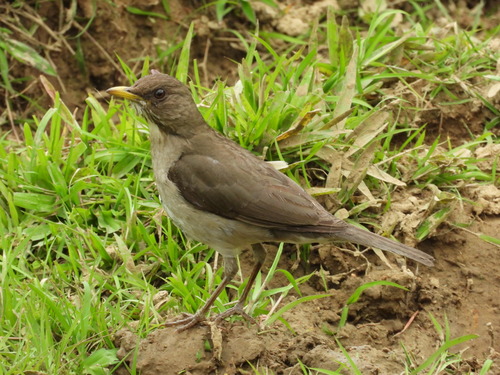
Creamy-bellied Thrush
Turdus amaurochalinus
A familiar and melodic presence in South American backyards, the Creamy-bellied Thrush is a master of the garden lawn and a favorite for AI-powered birdwatching.
Quick Identification
Size
22-25 cm (8.7-9.8 in) long; weighs approximately 55-75 g (1.9-2.6 oz)
Colors
Olive-brown upperparts, creamy-white belly, yellowish bill with a dark tip, and a finely streaked white throat.
Key Features
- Bright yellow bill with a dusky tip
- Pale, creamy-white lower underparts
- Finely streaked throat and pale eye-ring
- Olive-brownish back and wings
When You’ll See Them
Geographic range
Where Does the Creamy-bellied Thrush Live?
The Creamy-bellied Thrush is native to the vast landscapes of South America. Its core range stretches across central and eastern Brazil, extending through Paraguay, Uruguay, and northern Argentina into eastern Bolivia and parts of Peru. While many populations remain resident year-round, southern birds are known to migrate north during the winter, occasionally appearing as vagrants in Chile and the Falkland Islands.
Basemap © OpenStreetMap contributors
Behavior
The Creamy-bellied Thrush is an energetic and highly adaptable bird, often found hopping across suburban lawns and forest clearings. Much like its North American or European cousins, it is a terrestrial forager that uses a 'run-and-stop' technique to locate earthworms and insects hidden in the grass. It is generally bold around humans and has become a staple of urban biodiversity across South America.
During the breeding season, males are known for their beautiful, flute-like songs, which they deliver from high, exposed perches during the early morning and late evening. While they are usually seen alone or in pairs, they can be quite social during the winter months, occasionally forming loose flocks around abundant food sources like fruiting trees or shrubs.
EverydayEarth exclusive
Camera Tips
To capture the best footage of a Creamy-bellied Thrush, ground-level camera placement is essential. These birds spend the majority of their active hours foraging on the floor, so mounting your AI camera 12 to 18 inches above the ground near a lawn or under a fruiting tree will yield the most frequent captures. Angle the camera slightly downward to ensure the bird’s distinctive yellow bill and streaked throat are in focus.
Water is a powerful magnet for this species. They are enthusiastic bathers and will visit shallow birdbaths or ground-level water features daily. Positioning your camera near a water source with good natural light will not only help the AI identify the species more accurately but also provide entertaining videos of their vigorous splashing behavior.
While they don't often visit hanging seed feeders, you can lure them into the camera's view by offering 'soft' foods on a platform or directly on a clean patch of earth. Chopped apples, bananas, or dried mealworms are irresistible to them. Try to place these baits in an area where the bird feels safe—close to a hedge or shrubbery where they can quickly retreat if they feel threatened.
Pay attention to the light; the Creamy-bellied Thrush is most active at dawn. If your camera settings allow for it, increase the motion sensitivity during the early morning hours. This is when they are most likely to be hopping across the grass in search of worms, providing the perfect opportunity for your AI camera to log their presence.
Similar Species
Species that look similar or are commonly confused with Creamy-bellied Thrush.
Pale-breasted Thrush
The Pale-breasted Thrush has a more uniform brownish-grey breast and a darker, less yellow bill compared to the Creamy-bellied Thrush.
Rufous-bellied Thrush
Easily distinguished by its vibrant orange-rufous underparts, which contrast sharply with the Creamy-bellied's pale whitish belly.
Frequently Asked Questions
Record Creamy-bellied Thrush at your habitat
Connect a camera to start building your own species record — AI identifies every visitor automatically.