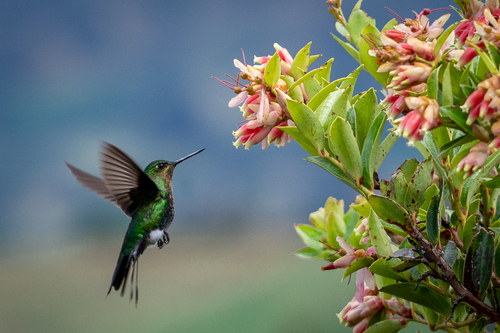
Glowing Puffleg
Eriocnemis vestita
A high-altitude marvel of the Andes, the Glowing Puffleg dazzles with iridescent violet plumage and its signature white 'booties.' This resilient hummingbird is a master of the misty cloud forests, darting between mountain blooms with unmatched agility.
Quick Identification
Size
Length: 9–10 cm (3.5–4 in); Weight: 4.4–5.2 g (0.15–0.18 oz)
Colors
Male is deep glittering green with a brilliant violet-blue rump and throat; female is paler green with white-scaled underparts. Both sexes feature iconic white 'puff' feathers on the legs.
Key Features
- Distinctive white cottony feather puffs on the legs
- Deeply forked, steel-blue to black tail
- Iridescent violet-blue patch on the rump and upper tail coverts
When You’ll See Them
Geographic range
Where Does the Glowing Puffleg Live?
The Glowing Puffleg is a native treasure of the northern Andes in South America. Its primary range follows the high-elevation mountain chains through Colombia, Ecuador, and western Venezuela, with smaller populations extending into the northern reaches of Peru. This species is a mountain specialist, rarely venturing below the cloud forest line, making it a staple of the high-altitude misty forests that define the Andean landscape.
Basemap © OpenStreetMap contributors
Behavior
The Glowing Puffleg is a high-energy inhabitant of the Andean clouds, known for its territorial and somewhat aggressive nature. Like many hummingbirds in the 'brilliant' tribe, it spends much of its day defending rich nectar sources from competitors. It is an active forager that employs a 'trap-lining' strategy, flying a regular route between scattered flowering plants, though it will also vigorously defend a single productive bush or garden feeder.
When not feeding, these birds can be found perching on low, sheltered branches to conserve energy in the thin mountain air. Despite the harsh, often cold conditions of their high-altitude home, they are remarkably resilient. They are generally solitary except when mating or when several individuals gather at a particularly abundant food source, though even then, brief aerial skirmishes are common as they re-establish their personal space.
EverydayEarth exclusive
Camera Tips
To capture the Glowing Puffleg on camera, focus your efforts on high-altitude garden settings or forest edges where tubular red or orange flowers are blooming. Because these birds move with incredible speed, a camera with a fast shutter speed or a high-frame-rate video setting is essential. Position your camera approximately 3 to 5 feet away from a cluster of nectar-rich flowers like Fuchsia, and try to angle it so the sun is behind you; this will best highlight the bird's iridescent violet rump and throat patch.
If you are using a backyard feeder to attract them, choose one with a perch. While many hummingbirds feed on the wing, providing a resting spot encourages the Puffleg to stay still for several seconds, allowing for much sharper images of their distinctive leg puffs. Set your camera's trigger sensitivity to high, as their small size and rapid movements can sometimes be missed by standard motion sensors.
Given the misty and often damp conditions of the Andean cloud forest, equipment protection is vital. Use a weather-sealed camera housing or a small 'roof' over your camera setup to prevent lens fogging and moisture damage. Early morning is the best time for photography, as the birds are most active in their search for nectar to replenish calories lost during the cold mountain nights.
Similar Species
Species that look similar or are commonly confused with Glowing Puffleg.
Frequently Asked Questions
Record Glowing Puffleg at your habitat
Connect a camera to start building your own species record — AI identifies every visitor automatically.