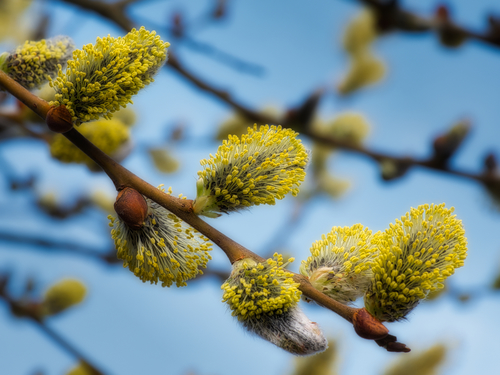
goat willow
Salix caprea
Famous for its soft, silvery catkins that resemble tiny paws, the goat willow is a vital harbinger of spring. It serves as a bustling hub for early-season pollinators and provides essential shelter for backyard wildlife.
Quick Identification
Size
6-15m (20-50ft) tall with a spread of up to 8m (26ft)
Colors
Silvery-grey catkins, golden-yellow pollen, dull green leaves with felt-like grey undersides, grey-brown bark
Key Features
- Soft, oval catkins (pussy willows) appearing before leaves
- Broadly oval leaves with a small 'kink' at the tip
- Diamond-shaped pits on mature bark
- Non-brittle twigs that are yellowish-green to reddish-brown
When You’ll See Them
Behavior
The goat willow is a rugged pioneer, often the first tree to establish itself in open clearings or disturbed ground. Unlike its relatives that typically hug riverbanks, this 'sallow' thrives in a variety of conditions, including drier woodland soils and suburban gardens. It is dioecious, meaning individual trees are either male or female. The male trees produce the iconic yellow, pollen-heavy catkins, while females produce more slender, green seed-bearing flowers.
In the backyard ecosystem, the goat willow acts as a vital early-season service station. Because it blooms as early as March, it provides some of the first nectar and pollen available to queen bumblebees and butterflies emerging from hibernation. Its presence significantly boosts local biodiversity, supporting over 200 species of insects and providing dense nesting sites for various garden birds.
EverydayEarth exclusive
Camera Tips
Capturing the life around a goat willow requires a strategic approach focused on its flowering cycle. To film the iconic 'pussy willow' stage, mount your camera 4 to 6 feet high on a nearby post or a sturdy branch, angled toward a cluster of male catkins. Since these trees are early bloomers, ensure your camera has fresh lithium batteries to withstand the lingering cold of March and April. A time-lapse setting, taking a photo every 30 minutes, can beautifully document the transition from silvery-grey buds to golden-yellow flowers.
To capture the wildlife that this tree attracts, set your camera to a high-sensitivity motion trigger or 'hybrid mode' (video and photo). The goat willow is a magnet for the first butterflies of the year, such as the Brimstone and Peacock. Position your camera on the side of the tree that receives the most morning sun, as this is where insects will congregate to warm up and feed. If you are using a trail camera with a fixed focus, try to keep the catkins at least 3-5 feet away to avoid blurry images, or use a camera with a dedicated macro lens for stunning close-ups of visiting bees.
Don't forget the ground-level activity. The fallen catkins and the insects they attract often bring in ground-feeding birds. Placing a second camera at the base of the trunk can capture dunnocks or chaffinches foraging through the leaf-litter. In the autumn, the dense foliage provides excellent cover; look for movement within the leaves to catch sight of nesting birds. Adjust your PIR (Passive Infrared) sensor to a medium setting to prevent the swaying branches from triggering the camera on windy days, which is a common challenge with willow photography.
Similar Species
Species that look similar or are commonly confused with goat willow.
Frequently Asked Questions
Record goat willow at your habitat
Connect a camera to start building your own species record — AI identifies every visitor automatically.