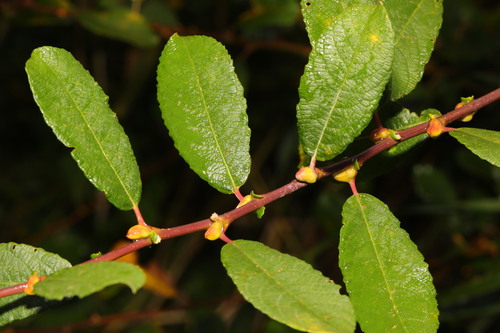
Grey Willow
Salix cinerea
The Grey Willow is the unsung hero of the damp garden, offering vital early-spring nectar and dense nesting cover. Known for its iconic 'pussy willow' catkins, this hardy tree is an essential anchor for backyard biodiversity.
Quick Identification
Size
Height: 4–10m (13–33 ft), occasionally reaching 15m (49 ft); Spread: 4–8m (13–26 ft).
Colors
Grey-brown bark with diamond-shaped fissures; dull green leaves with soft grey, downy undersides; silver-grey catkins that turn yellow (male) or green (female).
Key Features
- Oval leaves with a fine coating of grey hairs on the underside
- Diamond-shaped fissures in the bark of mature trunks
- Soft, felt-like 'pussy willow' catkins appearing before leaves
- Multi-stemmed, shrubby growth habit often found in damp soil
When You’ll See Them
Behavior
While it may not move like the animals usually captured on trail cameras, the Grey Willow is a dynamic and essential part of the backyard ecosystem. It is one of the first plants to 'wake up' in the spring, producing its iconic soft catkins as early as March. These catkins are a vital early-season nectar source for queen bumblebees and hoverflies emerging from hibernation. Because it grows quickly and tends to form dense, scrubby thickets, it serves as an excellent natural privacy screen and a sturdy windbreak for more delicate garden plants.
In the wild, Grey Willow is a pioneer species, often being among the first to colonize damp, disturbed ground. In a garden setting, it interacts with humans primarily as a structural plant that manages waterlogged soil. It is relatively short-lived compared to oaks or maples, but its ability to regenerate through coppicing means it can remain a permanent fixture in your landscape for decades if managed properly. Its presence often signals a healthy, moist microclimate that will attract a high diversity of insect and bird life.
EverydayEarth exclusive
Camera Tips
Capturing a Grey Willow on your AI camera isn't just about the tree—it's about the incredible volume of wildlife it hosts. To get the best results, position your camera about 5 to 7 feet away from a cluster of spring catkins. Because these flowers are among the first to appear in spring, they act as a magnet for early pollinators. Use a camera with a high-trigger speed or a macro-focus setting to capture the rapid movement of honeybees and emerging butterflies against the soft texture of the 'pussy willow' buds.
If you are looking to capture bird activity, the Grey Willow’s dense, twiggy interior is a favorite nesting site for smaller species like warblers and finches. Mount your camera on a nearby fence post or a different tree trunk, angled slightly upward into the canopy. Look for the 'V' where branches split, as these are prime spots for nests. Use a wide-angle lens if possible to capture the entry and exit patterns of parent birds during the late spring nesting season.
For those interested in the tree's growth cycle, the Grey Willow is a perfect subject for a long-term time-lapse. Set your camera to take one photo every 24 hours at mid-day. Over the course of March and April, you will see the dramatic transformation from silver, furry buds to bright yellow pollen-heavy flowers, followed by the sudden explosion of green leaves. Ensure your camera is securely mounted to a permanent structure to prevent 'camera shake' from wind, which can ruin a long-term time-lapse sequence.
In the autumn and winter, the Grey Willow’s structure becomes a haven for sheltering mammals. If you have a trail camera with infrared night vision, place it at ground level near the base of the trunk. The thicket-like base often provides cover for hedgehogs, rabbits, or even foxes looking for a dry spot to rest. Avoid using heavy white-light flashes at night, as the reflective grey bark can cause 'hot spots' or overexposed images; stick to low-glow infrared settings for the best nighttime clarity.
Finally, consider the sun's path when setting up your camera. Because the leaves of the Grey Willow have a silvery, downy underside, they can catch the golden hour light beautifully. Pointing your camera East or West so the sun hits the leaves at an angle will highlight the unique texture and color of the foliage, making for much more professional-looking backyard captures than a direct-overhead sun would provide.
Similar Species
Species that look similar or are commonly confused with Grey Willow.
Frequently Asked Questions
Record Grey Willow at your habitat
Connect a camera to start building your own species record — AI identifies every visitor automatically.