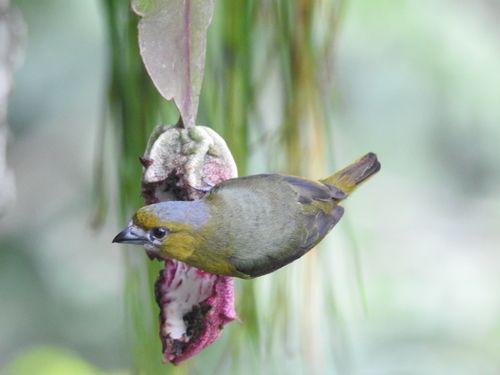
Golden-bellied Euphonia
Euphonia chrysopasta
A radiant jewel of the Amazonian canopy, the Golden-bellied Euphonia is famous for its shimmering yellow plumage and its role as a master mistletoe gardener. This small but vocal songbird is a favorite for birdwatchers and backyard researchers alike.
Quick Identification
Size
Length: 10–12 cm (4–4.7 in); Weight: 12–16 g (0.42–0.56 oz)
Colors
Males are olive-green above with bright golden-yellow underparts and a characteristic white lore (the area between the eye and beak). Females are generally duller and more uniform yellowish-green.
Key Features
- Distinctive white patch (lore) in front of the eye
- Golden-yellow belly and vent area
- Short, thick-based bill
- Small, plump 'finch-like' silhouette
When You’ll See Them
Geographic range
Where Does the Golden-bellied Euphonia Live?
Native to the vast tropical heart of South America, the Golden-bellied Euphonia is a staple of the Amazon Basin. Its core range spans across northern and central Brazil, extending through the lush lowlands of Peru, Colombia, Ecuador, and Bolivia. It is also frequently spotted in the Guianas and parts of southern Venezuela, thriving in areas where humid forests meet open clearings. While it remains a resident across its range, its presence is most concentrated in the pristine riverine corridors of the Amazonian interior.
Basemap © OpenStreetMap contributors
Behavior
The Golden-bellied Euphonia is a highly active and social songbird, often found moving in pairs or small family groups. Unlike many other euphonias that stay strictly in the high canopy, this species frequently visits forest edges and clearings, making it a wonderful candidate for backyard observation in its native range. They are known for their sweet, whistling songs and their remarkable ability to mimic the calls of other birds, a trait they use to blend into mixed-species foraging flocks.
These birds are fascinating to watch because of their specialized feeding behavior. They have a symbiotic relationship with mistletoe; they eat the berries and then 'wipe' the sticky seeds onto branches, effectively planting the next generation of fruit. While they are generally shy around humans, they are bold when it comes to defending a productive fruiting tree from other small birds.
EverydayEarth exclusive
Camera Tips
To capture the Golden-bellied Euphonia on camera, height is your biggest advantage. While they occasionally descend to lower shrubs, they prefer the mid-to-upper canopy. If you have a second-story balcony or can safely mount your camera 10-15 feet high near a fruiting tree, you’ll have much better luck. Aim the lens at horizontal branches rather than vertical trunks, as these birds love to perch and shuffle along branches while searching for berries.
Food is the best lure for this species. If you live in their range, planting or maintaining mistletoe-bearing trees is a guaranteed way to attract them. Alternatively, platform feeders stocked with overripe bananas or halved papayas can entice them down from the canopy. Position your camera about 3-5 feet from the food source to ensure the AI can clearly distinguish the white lore and golden belly markings.
Since these birds are fast movers, use a high shutter speed or a 'burst' photo mode if your camera supports it. They are most active in the early morning light when the sun first hits the treetops. Set your camera to be most sensitive during the 'Golden Hour' (6-8 AM). Because they often travel in pairs, keep the field of view slightly wider than you would for a solitary bird to capture their social interactions.
Similar Species
Species that look similar or are commonly confused with Golden-bellied Euphonia.
Frequently Asked Questions
Record Golden-bellied Euphonia at your habitat
Connect a camera to start building your own species record — AI identifies every visitor automatically.