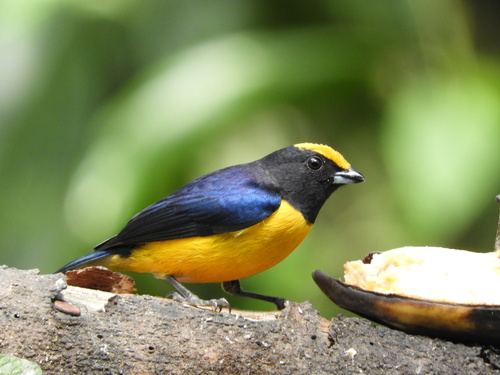
Orange-bellied Euphonia
Euphonia xanthogaster
A tiny, vibrant spark of the tropical canopy, the Orange-bellied Euphonia is famous for its stunning citrus-colored plumage and its love for mistletoe berries. This energetic finch is a must-see for any bird enthusiast exploring the humid forests of the Americas.
Quick Identification
Size
Length: 10–11 cm (4 inches); Weight: 9–16 g (0.3–0.6 oz)
Colors
Males have deep violet-black upperparts, a bright yellow-orange forehead patch, and a vibrant orange-yellow belly. Females are primarily olive-green above with a greyish nape and a pale yellow-buff belly.
Key Features
- Vibrant orange-yellow belly and chest
- Violet-black upperparts in males
- Short, thick, finch-like bill
- Small, compact body shape
When You’ll See Them
Geographic range
Where Does the Orange-bellied Euphonia Live?
The Orange-bellied Euphonia is a widespread gem of Central and South America, stretching from the tropical woodlands of Panama through the Andean foothills. Its heartland covers the vast Amazonian regions and humid highlands of Colombia, Ecuador, Peru, Bolivia, and Venezuela, extending into the Guyanas and parts of western Brazil. It is a permanent resident throughout its range, favoring areas with high humidity and consistent fruit availability.
Basemap © OpenStreetMap contributors
Behavior
The Orange-bellied Euphonia is a high-energy acrobat of the tropical canopy. Known for its restless nature, it spends much of its day flitting through the mid-to-upper levels of the forest, often hanging upside down to reach small fruits or berries. They are social birds, frequently seen in pairs or as active participants in mixed-species foraging flocks alongside tanagers and honeycreepers.
Unlike many other small birds, they have a specialized digestive system adapted for mistletoe berries, which are a staple of their diet. They are vocal residents of the rainforest, emitting high-pitched, metallic 'tee-tee' calls that help birdwatchers locate them even when they are obscured by dense tropical foliage. While they are not particularly shy, their preference for the treetops means they are rarely seen at ground level.
EverydayEarth exclusive
Camera Tips
To capture the Orange-bellied Euphonia on an AI-powered camera, you need to look up. These birds rarely descend to the forest floor, so mounting your camera at head height or higher is essential. If you have a balcony or a structure near the forest canopy, place your camera there, focused on a high-mounted bird bath or a platform feeder. They are particularly attracted to water sources in the dry season.
For baiting, these birds are fruit specialists. Halved oranges, overripe bananas, or papaya slices placed on a raised platform will often lure them into camera range. Ensure your camera is set to a fast trigger speed; euphonias are quick and tend to 'dart' in and out of frame. If your camera settings allow, use a high-frame-rate video mode to capture their rapid movements and the iridescent sheen of the male's plumage.
Lighting is your biggest challenge in dense forests. Aim for a spot where dappled sunlight hits the feeder or perch between 8:00 AM and 10:00 AM. Avoid direct, harsh midday sun, which can wash out the vibrant orange tones of their underparts. Using a camera with a macro-focusing capability or a narrow field of view is ideal, as these birds are quite small and can easily get lost in a wide-angle landscape shot.
Similar Species
Species that look similar or are commonly confused with Orange-bellied Euphonia.
Thick-billed Euphonia
The Thick-billed male has yellow extending further back on the crown, and as the name suggests, a noticeably heavier beak.
Violaceous Euphonia
Males have a more extensive yellow crown patch and the upperparts are more distinctly blue-violet rather than blackish.
Golden-bellied Euphonia
Distinguished by its brighter yellow (less orange) underparts and different distribution, primarily in Central America.
Frequently Asked Questions
Record Orange-bellied Euphonia at your habitat
Connect a camera to start building your own species record — AI identifies every visitor automatically.